
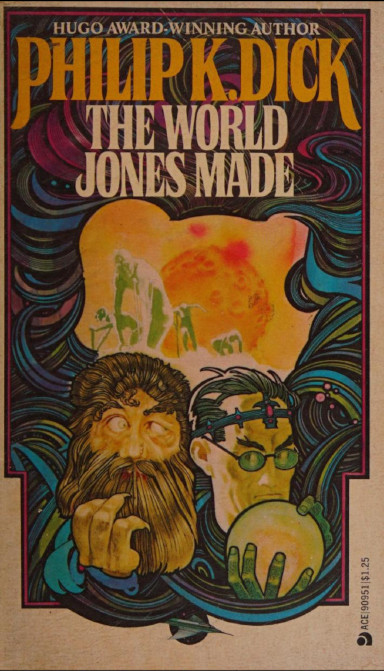
The novel “The World Jones Made” by Philip K. Dick was published for the first time in 1956.
Doug Cussick works for federal security and decides to report a fortune teller named Floyd Jones to his superiors. Initially, they think he’s a small potato and not worth arresting, but when Cussick claims that Jones spoke of alien creatures arriving to Earth, they realize he knows secret information.
Jones’ interrogation shows that he does indeed know the future, at least for a year. Cussick discovers that alien creatures do exist, even if they appear to be only single-celled organisms, who are arriving on Earth and have been dubbed wanderers. A plan to eliminate Jones fails, and it ends up helping him seize power while a project to colonize Venus is underway.
Written in 1954 but published only two years later, “The World Jones Made” ended up being Philip K. Dick’s second published novel. It depicts a world that survived an atomic war, where a world government has decided to establish relativism as the rule, given that differences were the cause of the war. Another element that became recurring in Dick’s stories is the presence of a major character with mental powers.
In the early years of his career, Philip K. Dick was still developing his style, and certain themes in this novel show various influences. At least some of the mutants born after the atomic war are more reminiscent of those of A.E. van Vogt than of Dick’s typical characters. Generally, mutations are the direct result of radiation, but this isn’t always the case.
Jones is a mutant with precognitive abilities, but despite the success he achieves with his knowledge of the future, he displays insecurities and fragility. At the same time, the growth in the number of his followers makes him an almost messianic figure, so much so that some follow him fanatically. His use of propaganda, tinged with patriotism and xenophobia, makes him somewhat of an antihero, and here Philip K. Dick clearly moves far away from A.E. van Vogt’s stories.
Other mutants are part of an experiment in colonizing the planet Venus. This novel was written at a time when there were still those who believed it to be a planet warmer than Earth but still relatively habitable, at least for those with certain adaptations. This part of the story may seem disconnected from the main plot, almost a tale within a tale, but in the end, everything comes together.
Among mutants of various kinds, the protagonist is a relatively ordinary man, Doug Cussick, who ends up involved in crucial events because he works for federal security. In many ways, he’s a witness to those events because he’s part of a vast apparatus of a world that has become a vast police state. Events affect him in various ways, and he also experiences personal problems with his wife, a character with some negative traits.
“The World Jones Made” is far from a perfect novel, yet it offers interesting food for thought about various themes. There’s a relativism that is supposed to eliminate conflict, but it’s applied in a way that generates ideological dullness. There are populist trends based on external enemies. Other social issues drawn from the era in which Philip K. Dick was writing and biological experiments raise ethical and moral questions. There are so many ideas, often jumbled together in chaotic ways.
Philip K. Dick was still learning the art of writing and working in a market that required him to write quickly. Despite this, I believe “The World Jones Made” remains a novel that can still be interesting for the ideas it contains and for readers interested in the author’s professional history. You can find it on Amazon USA, UK, and Canada.
