
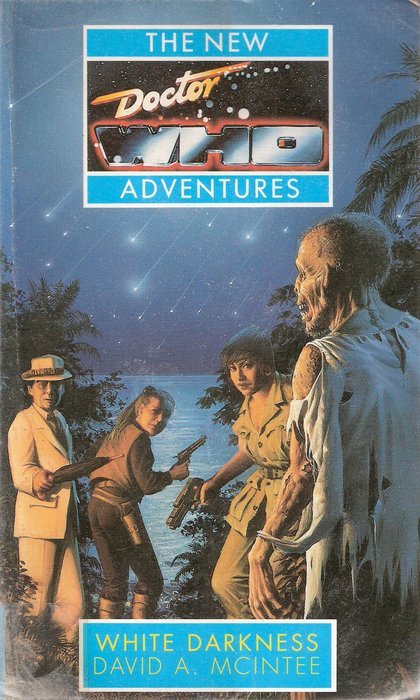
The novel “White Darkness” by David A. McIntee was published for the first time in 1993. It’s No. 15 in the “New Adventures” range by Virgin Publishing and follows “Lucifer Rising”.
Recent adventures have been rather stressful, and having two companions aboard the TARDIS doesn’t exactly help one relax. Consequently, the Seventh Doctor decides to stop off at a tropical location during a relatively uncomplicated era, such as the early 20th century. However, the TARDIS takes him, Ace, and Bernice to Haiti in 1915.
The travelers find themselves caught in the middle of one of the revolutions that periodically sweep the island, further complicated by spies and soldiers from various nations pursuing their own agendas. Danger also arises from practitioners of Vodoun. The Doctor must navigate the various threats, finding an ally in Dr. Howard Phillips.
“White Darkness” follows the tradition of historical serials typical of the early years of the classic “Doctor Who” series. Originally created with the educational purpose of teaching history to younger viewers, this format was largely abandoned in later eras in favor of adventures that incorporated science-fiction elements even when set on Earth in the past.
David A. McIntee conducted extensive research into Haitian history, particularly of the early 20th century. A key element of this history is Vodoun, also known as Voodoo. It’s a genuine religion, but in the Western world it’s best known for the concept of zombies. The author drew heavily on anthropologist Wade Davis’s book “The Serpent and the Rainbow” for reference, particularly regarding the drugs believed to be used in the process of zombification.
Another significant element of the novel is the incorporation of the Lovecraftian pantheon into the “Doctor Who” fictional universe. A major character is Dr. Howard Phillips, an explicit homage to H.P. Lovecraft, but there are equally explicit references to the “Necronomicon” and ancient entities known as the Old Ones and the Great Old Ones.
The Doctor had already encountered various types of highly powerful entities—some even comparable to gods—in various serials of the classic series. This means that the introduction of yet another pantheon stands out mainly because it involves a modern mythology created for another fictional universe. In this case, these entities are merely referenced within a story that tackles the theme of zombies, portrayed here as humans falling victim to a combination of drugs.
The result is a story that blends diverse elements drawn from various genres. Even within the horror genre alone, it mixes Lovecraftian cosmic horror with the zombie subgenre. The historical setting of 1915 Haiti also incorporates espionage elements linked to the interests of various nations. The narrative depicts the era without glossing over the issue of racism; indeed, racism is a pervasive and significant presence, which includes the use of racial slurs!
David A. McIntee may perhaps overreach with this blend of elements, which at times struck me as somewhat chaotic. The cast of characters is also quite large considering the novel’s limited length; some characters seem included solely to be killed off, while only a few of them are well-developed. Particularly for the Doctor’s companions, it’s a grim tale.
In the end, “White Darkness” is a novel in which David A. McIntee combines history with science fiction and horror, creating a story that starts at a slow pace before picking up speed. It’s a mix that might seem strange even to “Doctor Who” fans, yet this makes it interesting for readers who manage to immerse themselves in the plot and appreciate at least some of its elements.

Permalink