May 2014

Koichi Wakata, Mikhail Tyurin and Rick Mastracchio assisted after their landing (Photo NASA TV)

A few hours ago the Japanese astronaut Koichi Wakata, the American astronaut Rick Mastracchio and the Russian cosmonaut Mikhail Tyurin returned to Earth on the Soyuz TMA-11M spacecraft, which landed safely in Kazakhstan. The three of them spent almost exactly six months on the International Space Station, where they arrived on November 7, 2013. Initially, they were part of Expedition 38, in the second half of their stay they were part of Expedition 39 with Koichi Wakata as commander of the Station.

The square-shaped coronal hole on the Sun's surface (Image Solar Dynamics Observatory/NASA)

NASA’s Solar Dynamics Observatory (SDO) space probe has discovered a square-shaped coronal hole in the Sun’s corona, the outer part of the atmosphere of our star. It’s far south on the Sun so it’s unlikely that the solar wind originated in that area reaches Earth.

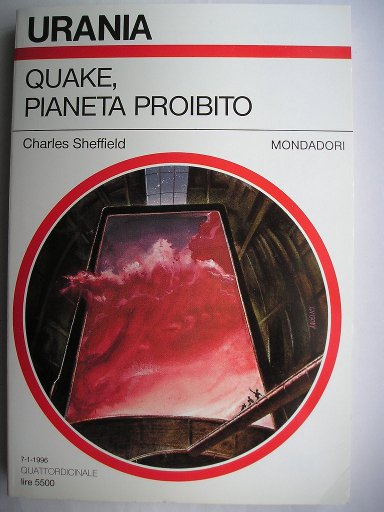
Summertide by Charles Sheffield (Italian edition)

The novel “Summertide” by Charles Sheffield was published for the first time in 1990. It’s the first book of the Heritage Universe.

Humans have spread among the stars, slowly at first, with starships traveling at speeds lower than light, and then much more quickly using the Bose communication network that allows fast interstellar travel. In the course of their travels they met various alien species but also artificial structures millions of years old built by an unknown species.

Quake is a planet in the Dobelle system. There a particular configuration periodically causes the Summertide, an extremely violent seismic phenomenon. Quake and its twin planet Opal are joined by the Umbilical, one of the structures of Builders, the mysterious species that left so many artificial structures. Once every about 350,000 years this this phenomenon is even more violent and in occasion of this super Summertide some humans and aliens arrive on Quake to investigate but they’re not all what they seem.

The position of the star HD 162826 (Image courtesy Ivan Ramirez/Tim Jones/McDonald Observatory. All rights reserved)

A team of researchers led by astronomer Ivan Ramirez of the University of Texas at Austin has identified the first Sun “sibling”. This star, identified as HD 162 826, almost certainly formed over 4.5 billion years ago in the same gas cloud in which the Sun formed along with thousands of other stars. The methods used to find it will help discover more of their “siblings” and also to understand in which part of the galaxy they formed.

Simulation of a galaxy cluster within Illustris (Image courtesy Illustris collaboration. All rights reserved)

A group of researchers coordinated by MIT (Massachusetts Institute of Technology) published in the journal “Nature” the results of the most sophisticated simulation of the universe ever produced. It’s Illustris, a project that led to the creation of a model to faithfully reproduce the evolution of the universe from 12 million years after the Big Bang to the present day.