Software

Blogs about software

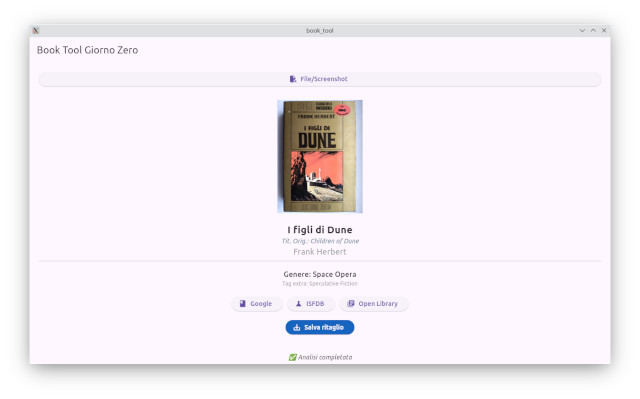
Book Assistant 0.1

A premise. This article isn’t intended to address the ethical and moral issues associated with the use of LLM (Large Language Models), as (alleged) artificial intelligence systems are called, and other tools connected to these systems. Like it or not, these tools have already been adopted by many individuals and businesses, and it will be increasingly necessary to know how to use them in one’s work.

I already wrote a few comments some time ago regarding the rush to adopt these tools by some of the major search engines. Here, I simply intend to share my personal experience developing an app that uses such a system to perform processes that would otherwise be extremely complex. For this reason, I also used this system as a development assistant, as it was my first experience with this type of software development.

Sam Altman in 2019

In less than a week, a showdown took place within the top management of OpenAI, an organization that began as a non-profit before creating a for-profit subsidiary. On Friday, November 17, the Board of Directors removed Sam Altman from his position as CEO and Greg Brockman from the Board. After frantic days of announcements, threats of mass resignations from the employees, further changes at the top, and the announcement of the move of Altman and Brockman to Microsoft, there was instead a restoration with the return of the two of them to their roles and the announcement of radical changes in the Board.

Scheme of the IBM Osprey quantum processor (Image courtesy IBM. All rights reserved)

At the IBM Quantum Summit 2022, IBM unveiled its new quantum processor. Called the IBM Osprey, it features 433 qubits, more than triple the IBM Eagle processor unveiled just last year. This great step forward in the field of quantum computers aims to make computers capable of performing complex calculations that are far beyond the capabilities of any classical computer. Software is as critical as hardware to performance, and IBM is working on the Qiskit Runtime, a service and programming model that aims to optimize workloads and run them efficiently on quantum computers.

An illustration of SeqScreen's workflow (A) and the machine learning training framework (B)

An article published in the journal “Genome Biology” reports the results of tests conducted with SeqScreen, a free / open source software developed to recognize genetic sequences existing in pathogenic microorganisms. A team of researchers led by computer scientist Todd Treangen of Rice University and genomics specialist Krista Ternus of the scientific consultancy firm Signature Science, LLC developed SeqScreen to analyze the characteristics of short DNA sequences often called oligonucleotides and improve the recognition techniques of sequences present in a sample that are at least potentially dangerous.

Some cabinets of the Frontier supercomputer (Photo courtesy Carlos Jones/ORNL, U.S. Dept. of Energy)

The American Frontier supercomputer has been crowned the new king of the Top 500 ranking. It has a speed that is more than twice that of the Japanese Fugaku, the previous king. This is the first exascale supercomputer, which means that it’s capable of exceeding the calculation capacity of 1 exaflop with 10^18 floating point operations per second. Frontier reaches 1.102 exaflops per second.