Linux

Blog about Linux

Book Assistant 0.1

A premise. This article isn’t intended to address the ethical and moral issues associated with the use of LLM (Large Language Models), as (alleged) artificial intelligence systems are called, and other tools connected to these systems. Like it or not, these tools have already been adopted by many individuals and businesses, and it will be increasingly necessary to know how to use them in one’s work.

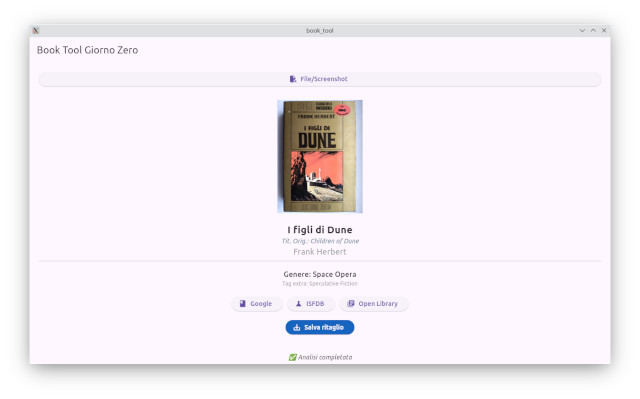
I already wrote a few comments some time ago regarding the rush to adopt these tools by some of the major search engines. Here, I simply intend to share my personal experience developing an app that uses such a system to perform processes that would otherwise be extremely complex. For this reason, I also used this system as a development assistant, as it was my first experience with this type of software development.

Some cabinets of the Frontier supercomputer (Photo courtesy Carlos Jones/ORNL, U.S. Dept. of Energy)

The American Frontier supercomputer has been crowned the new king of the Top 500 ranking. It has a speed that is more than twice that of the Japanese Fugaku, the previous king. This is the first exascale supercomputer, which means that it’s capable of exceeding the calculation capacity of 1 exaflop with 10^18 floating point operations per second. Frontier reaches 1.102 exaflops per second.

Linus Torvalds in 2014

On August 25, 1991, Linus Torvalds (photo ©Krd) announced in a message on the comp.os.minix newsgroup the project of a new operating system that actually diverged considerably from Minix. Unhappy with the Minix license, Torvalds adopted a license from the GNU project, the GPL, which seemed to him free enough. After a few weeks, the first Linux kernel was released. The availability of various components released by the GNU project and the contributions of several people who joined the project helped to spread it. Thirty years later, Linux is being used by virtually everyone in one way or another, even if only a small minority realize it.

Parts of the Fugaku supercomputer (Photo courtesy RIKEN Center for Computational Science (R-CCS))

The Japanese supercomputer Fugaku was crowned the new king of the Top 500 ranking by passing Summit, which held the title for two years. Fugaku has almost triple performance compared to its predecessor with a computing power of 415.5 Petaflops against 148.6 for a theoretical peak of 513.8 Petaflops against 200.8. As has been common for supercomputer kings for a long time, it uses the Linux operating system, specifically the Red Hat Enterprise Linux 8 distribution. An interesting novelty is that Fugaku is the first supercomputer king based on ARM architecture being built around 2.2GHz A64FX 48C processors. In the Top 500 ranking, only three other supercomputers are based on ARM architecture.

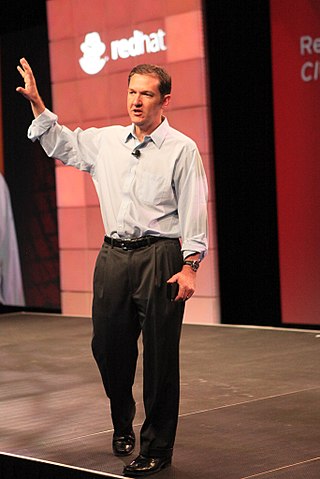
Jim Whitehurst in 2010

IBM and Red Hat announced that they have reached an agreement with which IBM will acquire all Red Hat’s shares, whose value closed last Friday at $116.68, for $190 per share paid in cash for a total value of about $34 billions. Red Hat will become part of IBM’s Hybrid Cloud division while its CEO Jim Whitehurst will join IBM’s senior management reporting to CEO Ginni Rometty. This acquisition is oriented above all to make IBM a giant in the field of cloud services.