Reptiles

Blogs about reptiles

Holotype of Tylosaurus rex, at the Perot Museum of Nature and Science, Texas (Photo Gary Todd)

An article published in the “Bulletin of the American Museum of Natural History” reports the identification of a new species of mosasaur, named Tylosaurus rex because its characteristics indicate it was a massive and fierce predator. A team of researchers reexamined Tylosaurus fossils previously attributed to other species of this taxonomic genus of mosasaurs, concluding that some specimens had anatomical characteristics different enough to warrant assignment to a new species.

The skeleton and a drawing of the Honghesaurus longicaudalis specimen

An article published in the journal “Scientific Reports” describes the identification of a new species of marine reptile with an exceptionally long tail that lived about 244 million years ago, in the Middle Triassic period, in today’s China. A team of researchers named it Honghesaurus longicaudalis after examining a complete skeleton discovered in the Guanling Formation in China’s Yunnan province. This reptile is part of the now-extinct group of pachypleurosaurs and was quite large among them, with a long trunk and tail that probably gave it swimming maneuverability and efficiency.

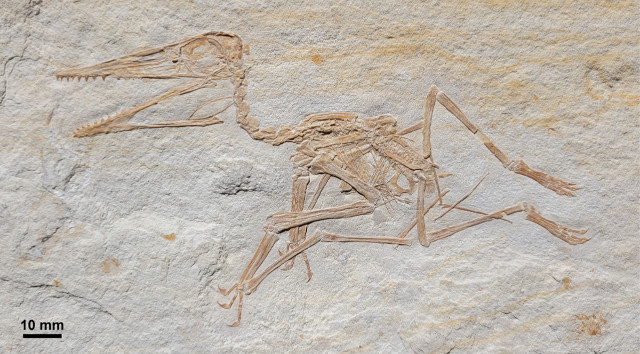
Painten's pterodactyl specimen

An article published in the journal “Fossil Record” reports a study on the oldest pterodactyl fossils discovered so far. A team of researchers examined a sub-adult specimen of Pterodactylus antiquus (Photo courtesy Augustin et al., all rights reserved) discovered in central Bavaria, Germany, which dates back to the sage known as the Kimmeridgian, part of the Upper Jurassic period. So far, the specimens dating from the Tithonian age, the next and last of the Jurassic period. This specimen is one of the best-preserved pterodactyl specimens, which is another reason why this discovery is important.

The specimen of Tupandactylus navigans with the drawing indicating its bones (Image Beccari et al)

An article published in the journal “PLoS ONE” reports the attribution of an almost complete pterosaur skeleton to the Tupandactylus navigans species. This fossil skeleton arrived in the hands of a team of researchers led by Dr. Victor Beccari in an adventurous way, as it was confiscated by the police along with other very well-preserved fossils during a raid at Santos Harbour, Brazil. The researchers subjected the skeleton to a CT scan that made it possible to create a 3D reproduction. The examination also led to the hypothesis that Tupandactylus navigans and Tupandactylus imperator actually constitute the two sexes of the same species.

Dromomeron gregorii fossil (Photo courtesy Sterling Nesbitt)

An article published in the journal “Nature” reports a study on Dromomeron gregorii, an archodon reptile that lived just over 210 million years ago, in the Triassic period. A team of researchers subjected recently discovered fossil skulls of this species to a micro-CT scan to reconstruct the structure of their brains and sensory systems. This allowed them to detect many similarities with pterosaurs that, together with other anatomical similarities, convinced them that they’re the ancestors of these flying reptiles.