July 2014

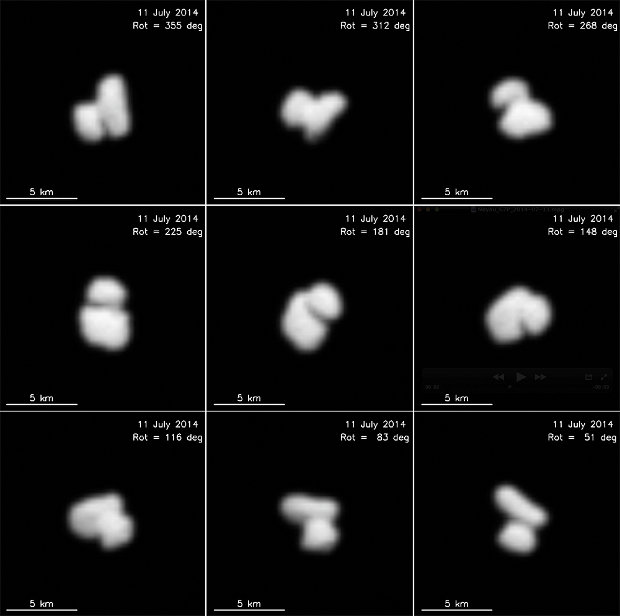
Assemblage of pictures that show the binary nucleus of the comet 67P/Churyumov-Gerasimenko taken by the Rosetta space probe (Image ESA / Rosetta / MPS for OSIRIS Team MPS / UPD / LAM / IAA / SSO / INTA / UPM / DASP / IDA)

ESA’s Rosetta space probe awakened in January 2014 after a journey that lasted almost ten years. In recent weeks, it started sending pictures of its target, the comet 67P/Churyumov-Gerasimenko. Yesterday, CNES, the French space agency, published a composition of photos taken on July 11 which show that the comet is composed of two nuclei that are attached, a fact that makes the Rosetta mission even more extraordinary.

After nearly a month spent going in and out the upper layer of the atmosphere of Venus, at an altitude between 130 and 135 km (about 81 to 84 miles), in recent days the Venus Express spacecraft has started the series of maneuvers that will bring it up to around 460 km (about 286 miles) of altitude. It wasn’t certain that Venus Express could survive the harsh conditions that are found even at those altitudes but this success will allow the probe to make a few more detections before running out of fuel and finally falling to the planet.

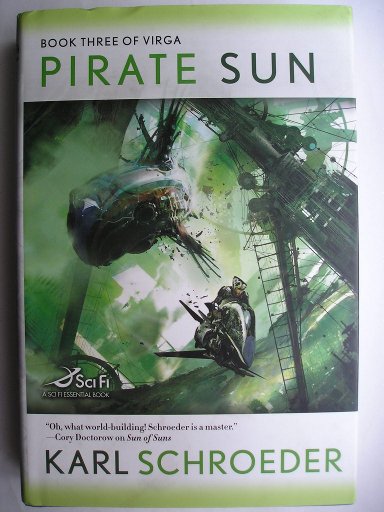
Pirate Sun by Karl Schroeder

The novel “Pirate Sun” by Karl Schroeder was published for the first time in 2008. It’s The third novel in the series of Virga.

Admiral Chaison Fanning was captured and imprisoned by his enemies. His wife Venera manages to set up his escape but he almost derails it because he wants at all costs to free two countrymen. Eventually, he manages to escape with them but is forced to improvise to bring the trio to safety from their enemies.

Soon, the three of them meet Antaea Argyre, a member of the semi-legendary group of Virga Home Guard, who aim to protect the artificial planet from external threats. Channing must try to return to his Slipstream but gets involved in a much larger story. In addition to understanding what Antaea really wants from him, he must find out why what he considered his best friend shows up in an enemy nation but apparently to recapture him.

Orbital Sciences Cygnus spacecraft blasting off atop an Antares rocket (Image NASA TV)

A little while ago, Orbital Sciences Corporation’s Cygnus spacecraft lifted off on an Antares rocket from the Mid-Atlantic Regional Spaceport (MARS), part of NASA’s Wallops Flight Facility (WFF) on Wallops Island, Virginia. After about ten minutes it successfully separated from the last stage of the rocket and started its journey. This is its second official mission, Orbital-2 or simply Orb-2, of transport of supplies to the International Space Station for NASA.