October 2014

The Kandinsky crater on Mercury photographed by the Messenger space probe (Image ASA/Johns Hopkins University Applied Physics Laboratory/Carnegie Institution of Washington)

An article published in the journal “Geology” illustrates the discovery of water ice on the planet Mercury made ​​thanks to NASA’s Messenger (Mercury Surface, Space Environment, Geochemistry and Ranging) space probe. Several pictures show frozen water and other materials in permanently shadowed craters near Mercury’s north pole.


Nikolay Davydenko at the 2009 U.S. Open

The Russian tennis player Nikolay Davydenko announced his retirement. During his career, he won several tournaments, especially the 2009 ATP Finals. He reached no. 3 of the ATP rankings.

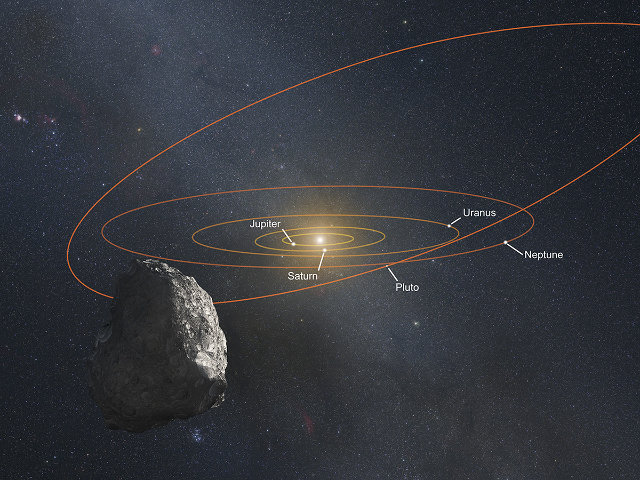
Artistic concept of a Kuiper Belt Object with its orbit compared to the ones of some planets (Image NASA, ESA, and G. Bacon (STScI))

NASA announced that it identified three potential targets for the mission of the New Horizons spacecraft after its Pluto flyby. They are Kuiper Belt Objects (KBOs) found using the Hubble Space Telescope exactly for this purpose.

The research program of KBOs was successful from the start, leading to the discovery of two interesting objects and then three more. In particular, the first object discovered, identified as 1110113Y, was subsequently defined certainty targetable. For this reason, it’s called PT1 by the team of the New Horizons mission.

RapidScat installed on the International Space Station using DEXTRE with the robotic arm Canadarm2 (Photo Alexander Gerst)

NASA has announced the successful activation of RapidScat (Rapid Scatterometer), a scatterometer transported to the International Space Station by the Dragon spacecraft and therefore also called ISS-RapidScat. It’s an instrument designed to monitor ocean winds to contribute to climate research, weather forecasting, and the monitoring of phenomena such as hurricanes. It’s an experimental instrument to use the Station as a platform for observations generally made ​​by satellites.