November 2014

The Serbian tennis player Novak Djokovic has won the ATP Finals 2014 after Roger Federer had to withdraw before the start of the final. For Djokovic this is the third consecutive title of “Master” of tennis. Federer paid for the struggled semifinal with back problems that forced him to withdraw from the final.

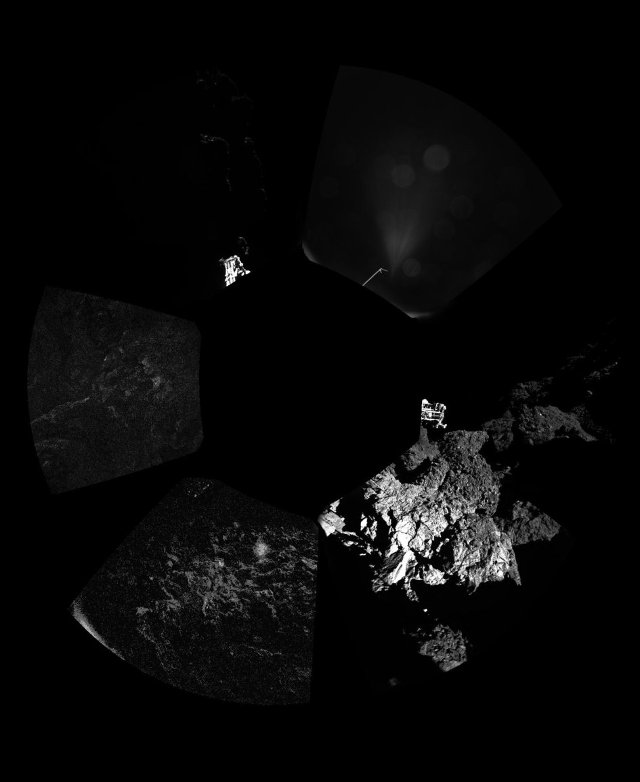
Panoramic image of the surface of the comet 67P/Churyumov–Gerasimenko around the Philae lander (Image ESA/Rosetta/Philae/CIVA)

After the understandable enthusiasm felt last Wednesday for the success of the Philae lander with its landing on the comet 67P/Churyumov-Gerasimenko, the team had to face the harsh reality. The area in which it ended up wasn’t the planned one and there it received much less light than expected. The consequence is that its batteries ran out of power a few hours ago making it hibernate. But before it worked for a few hours and transmitted a lot of data.

All this happened because the harpoons system that was supposed to anchor Philae to the ground didn’t work and the information gathered since then allowed to establish that it touched down three times before stabilizing. The instruments work but Philae was receiving much less sunlight than expected with serious consequences for the energy it had available for its instruments.

Bacteria of the species Escherichia Coli seen wih an electronic microscope (Image Rocky Mountain Laboratories, NIAID, NIH)

A group of MIT researchers has modified the DNA of bacteria of the species Escherichia coli – or simply E. coli – and used them as memories. A system called SCRIBE (Synthetic Cellular Recorders Integrating Biological Events) allows to easily write and read stably recorded memories, making them suitable for applications such as medical and environmental sensors.

Present orbits of the fifth and sixth Galileo satellites launched together by Soyuz on 22 August 2014 , in red, compared to their intended position, in dashed green, and the position of the four satellites launched in 2011 and 2012, in solid green (Image ESA)

ESA has announced that one of the two satellites of the Galileo constellation launched on August 22, 2014 and ended up in the wrong orbit will be moved in the course of this month. A problem of the Fregat last stage of the rocket caused the insertion of the two satellites in an orbit very different from the planned one. If the corrective maneuvers will be satisfactory, they’ll be repeated for the other Galileo satellite in the same situation.

The Philae lander seen by the Rosetta space probe during its descent on the comet 67P/Churyumov-Gerasimenko (Image ESA/Rosetta/MPS for OSIRIS Team MPS/UPD/LAM/IAA/SSO/INTA/UPM/DASP/IDA)

ESA has just confirmed that the Philae lander successfully landed on the surface of the comet 67P/Churyumov-Gerasimenko. It’s the first time that a spacecraft arrived from Earth manages to land on the surface of a comet. This success is the culmination of many years of effort but it’s just the beginning of a new phase of the Rosetta mission.