July 2017

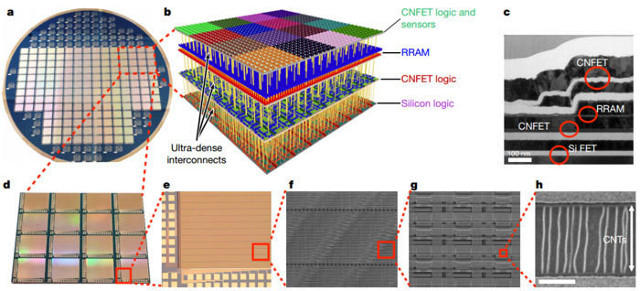
Scheme of the 3D chip (Image courtesy Stanford and MIT)

An article published in the journal “Nature” describes the creation of a new architecture for next-generation computers. A Stanford University and MIT team led by Max Shulaker, assistant professor at MIT, used experimental technologies such as carbon nanotubes and RRAM to create a prototype of a 3D chip that combines current computers’ CPU and RAM much faster in processing data and at the same time with a much lower power consumption.

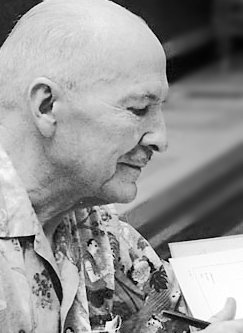
Robert Heinlein in 1976

Robert Anson Heinlein was born on July 7, 1907 in Butler, Missouri. He was one of the greatest science fiction writers, one of the first writers to publish his works in publications more prestigious than pulp magazines, which at the time didn’t enjoy a great consideration. He was also at the center of several controversies, especially for the ideas contained in “Starship Troopers”.

He had the tendencty to develop some ideas quite to the extreme but in different novels there are different ideas so for example “Starship Troopers” was blamed for militarism or even fascism while “Stranger in a Strange Land” became a point of reference for hippies.

Sometimes Robert Heinlein preached the ideas contained in his works but when he focused on the story the results were really great. His wife Virginia founded the Heinlein Society in 1997 to take care of the author’s enormous legacy. Without him science fiction would be very different.

Neanderthal Femur (Photo courtesy Oleg Kuchar © Museum Ulm)

An article published in the journal “Nature Communications” describes a genetic research on a European hominin whose bones were found in Germany in the Hohlenstein-Stadel cave. This individual is about 124,000 years old and is a Neanderthal but his mitochondrial DNA is different from that of the others of his species. According to the researchers at the Max Planck Institute for Evolutionary Anthropology in Leipzig, Germany, this indicates a crossbreeding with African hominins closely related to Homo sapiens.

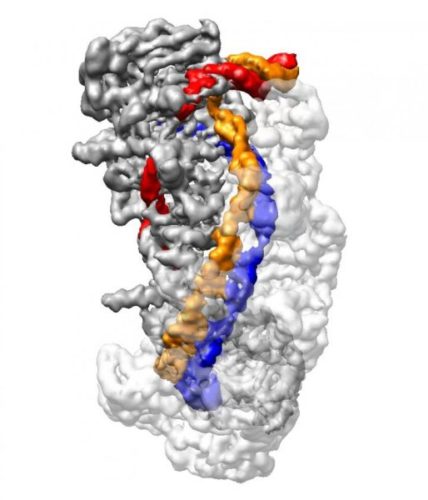
A cryo-electron microscope image of a CRISPR molecule (Image courtesy Liao lab/Harvard Medical School)

Two articles published in the journal “Cell” describe two different researches that are connected to one of the DNA modification systems known as CRISPR and especially the one known as CRISPR-Cas3. A team of scientists from Harvard Medical School and Cornell University generated an almost atomic-level snapshot of CRISPR revealing key steps in its operating mechanism. A team of scientists at the University of Texas at Austin and Cornell University took an important step towards the safety of medical applications of the CRISPR systems.

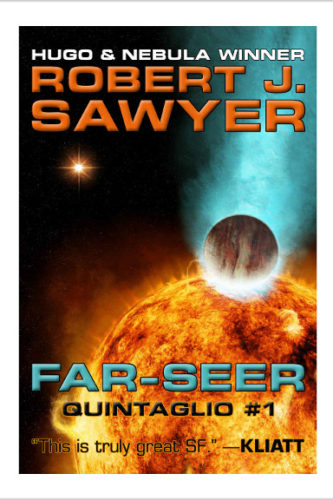
Far-Seer by Robert J. Sawyer

The novel “Far-Seer” by Robert J. Sawyer was published for the first time in 1992. It’s the first of the Quintaglio Ascension trilogy. It won the Homer Award as best novel of the year.

Afsan is an apprentice of the Imperial Court astrologer Tak-Saleed. He has reached the age appropriate to go through the coming-of-age rituals, participating in a hunt and a pilgrimage. He remains hurt during the hunt but his contribution to the killing of a big animal brings him honors.

On the ship carrying him on a pilgrimage, Afsan has the opportunity to talk to Captain Var-Keenir, who uses a far-seer, a new invention that allows him to see far away objects. His master refused to use that instrument but Afsan is too curious and asks the captain to lend him the instrument. His observations lead him to study the motion of celestial bodies but his conclusions go against religious precepts.