March 2018

Common raven (Corvus corax) (Photo National Park Service)

An article published in the journal “Nature Communications” brings evidence of an speciation reversal in two lineages of the species common raven (Corvus corax). A team of researchers examined genomic data from hundreds of ravens collected in North America in a study begun in 1999 concluding that this species diversified into three genetically distinct groups: the species Chihuahua raven (Corvus cryptoleucus) emerged from one of them but two of them are collapsing into one by a hybridization process.

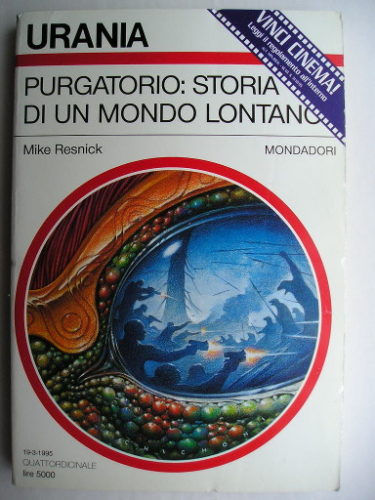
Purgatory by Mike Resnick (Italian edition)

The novel “Purgatory” by Mike Resnick was published for the first time in 1993. It’s the second book in the Galactic Comedy series and follows “Paradise”.

On the planet Karimon there’s a native species of sentient reptiles that reached the equivalent of the Earth’s Stone Age. The arrival of human beings on Karimon quickly disrupts that civilization, especially because the strong presence of precious minerals attracts many potential exploiters putting the planet at the center of considerable economic interests.

Jalanopi is the king of the Tulabetes, the strongest nation on the planet Karimon, but he has no hope of stopping the arrival of human beings with their advanced weapons. His only hope is to put humans against another alien species interested in the planet’s resources to obtain weapons and agreements that ensure the natives’ survival.

Tupanvirus soda lake (Image Nature Communications)

An article published in the journal “Nature Communications” describes the discovery of two species of giant viruses that were called Tupanvirus, attributed to the Mimiviridae family, the same that includes other giant virus species discovered in recent years. A team of researchers from various international institutions discovered these two viruses that are larger than some bacteria and have some unusual characteristics for viruses, such as the genes for the synthesis of a lot of proteins.

Little skate - Leucoraja erinacea (Photo Andy Martinez/NOAA)

An article published in the journal “Cell” describes a research on the origin of the types of neurons needed to coordinate walking on the mainland. A team of researchers from the New York University School of Medicine focused in particular on the species little skate (Leucoraja erinacea), part of the most primitive vertebrate group, studying its neuromuscular and genetic development. The conclusion is that some fish started walking on the sea floor about 420 million years ago, about 20 million years before the early tetrapods started colonizing the mainland.