September 2018

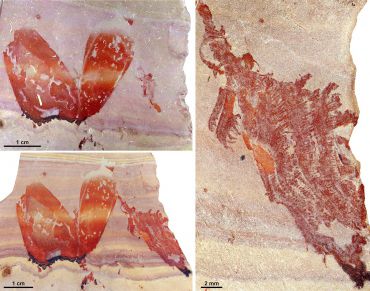
Pahvantia hastasta fossils (Image courtesy Stephen Pates / Rudy Lerosey-Aubril)

An article published in the journal “Nature Communications” describes a study on Pahvantia hastasta, a relative of today’s arthropods that lived about half a billion years ago, in the Cambrian period. Stephen Pates of the British University of Oxford and Rudy Lerosey-Aubril of the Australian New England University examined fossils discovered many years ago in the mountains of today’s Utah, USA, after extensive preparatory work. They believe that this species belonged to the group of radiodonts, that it fed on microplankton and that this type of aquatic animal contributed to kickstart the diversification of life forms on the seabed in the Cambrian Explosion.

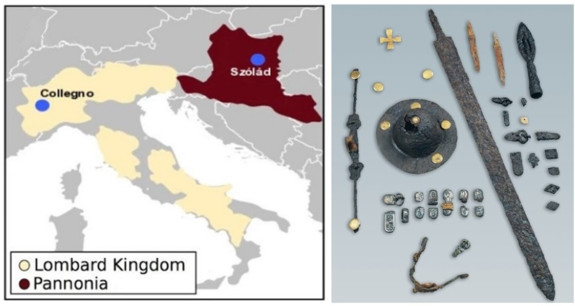
A paleogenomics research provides information on the Lombards' genetic ancestries and social structure

An article published in the journal “Nature Communications” describes a paleogenomics research that attempted to reconstruct some migrations of the barbarian populations in the 6th century C.E. through Europe. A team of researchers performed a multidisciplinary analysis that includes genetics, history and archeology to get new information on the movements of various populations during that chaotic period. Genetic data were obtained from 63 samples taken in two 6th century Lombard cemeteries, one in Szólád, in present-day Hungary, and one in Collegno, near Turin, in Italy, discovering that the richest graves tended to have ancestors from northeastern Europe while those in poorer tombs tended to have ancestors in southern Europe.

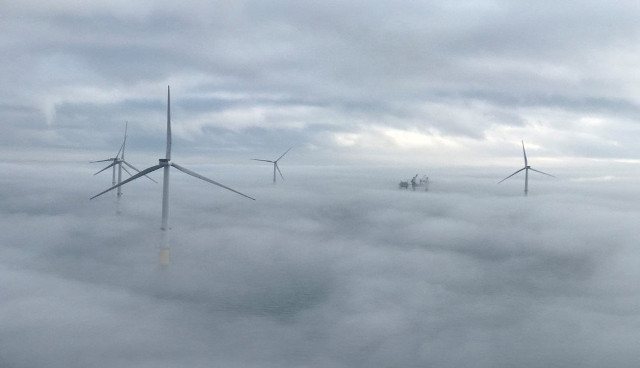
Some of Walney Extension's wind turbines (Photo courtesy Walney Extension)

A few days ago, the largest offshore wind farm off the Ireland coast has been inaugurated. Called Walney Extension, it’s a project of Danish company Ørsted capable of generating up to 659 MWatts to supply electricity for over 590,000 homes. This wind farm broke the record of another British farm, the London Array, which can generate up to 630 MWatts.

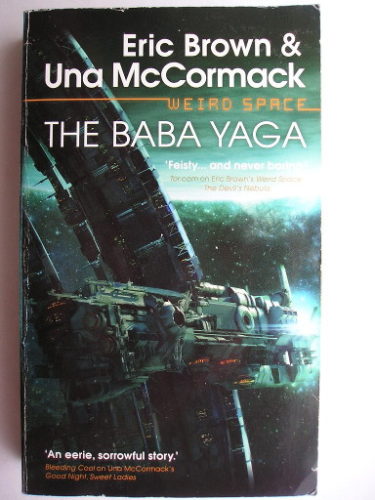
The Baba Yaga by Eric Brown and Una McCormack

The novel “The Baba Yaga” by Eric Brown and Una McCormack was published for the first time in 2015. It’s the third book of the Weird Space series and follows “Satan’s Reach”.

The Expansion’s government is taking very seriously the information gathered about the threat posed by the aliens known as the Weird but there are disagreements about the measures to be taken. For the intelligence services it’s difficult to get precise information about creatures that literally come from another universe but the prospect is to destroy the planets where the aliens have opened portals killing all the local population.

Delia Walker is an intelligence analyst who proposes to follow a trace that would lead her to search for a planet in the area of ​​space called Satan’s Reach where humans and Weird are said to live peacefully. Her position is definitely a minority but she believes it’s crucial to investigate so she decides to do it without the government’s support.

The short story “A Day to Remember” (“Un giorno da ricordare”) by Clelia Farris was published for the first time in 2017 by Strange Horizons in the translation by Rachel Cordasco.

Olì is a memory artist: she doesn’t just eliminate ugly memories cutting them out to leave the good ones but she modifies them to improve them. After the Great Frost there are many people who feel the need to forget something or at least to have pleasant memories and as payment they give Olì food or other items useful to her or to barter.