April 2025

Nowhere to Hide by Jude Austin

The novel “Nowhere to Hide” by Jude Austin was published for the first time in 2022. It’s the third book in the Projects series, later indicated as the Five Worlds series, and follows “Homecoming”.

Kalin Taylor, now known as Kata, is trying to rebuild his life but it seems that some people have no intention of leaving him alone, starting with his parents. Tau continues to write him emails but in his case, it’s an attempt to keep in touch with the first person who considered him a person and not a tool. Kurai tries to give Tau a hand but he too, albeit in a different way, must deal with his past.

Vasari Adrianne Demont of the planet Trandellia has her own agenda, and to get what she wants, she must capture a specific person on the planet Atthiras. She sends a group of holin, elite forces specialized in infiltration and assassination, to look for them. The holin are used to working alone or in small groups, without a hierarchy, so an operation conducted by a large group can create problems. Diran realizes that those problems can lead to clashes among the holin themselves, but the important thing is the success of the operation.


The Fifteenth Doctor (Ncuti Gatwa) in The Robot Revolution (Image courtesy BBC / Disney+)

“The Robot Revolution” is the first episode of the 15th season of the new “Doctor Who” series, also indicated as season 2. The show resumes after “Joy to the World”. It’s available in the UK and Ireland on BBC channels and in many other countries on the Disney+ platform.

Beware that in various adverts and marketing materials, this season is promoted as season 2 passing through a new start with the production by Bad Wolf and distribution by Disney+, hence the double notation.

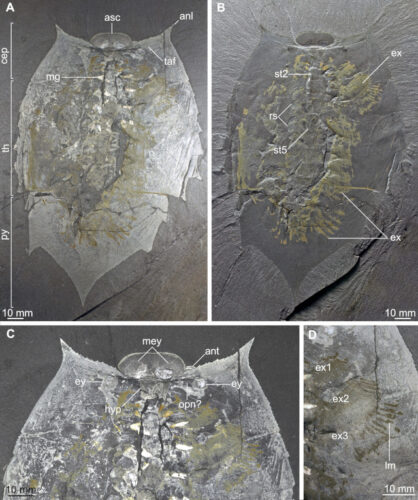
Various views of the holotype of Helmetia expansa (Image courtesy Jean-Bernard Caron and Sarah Losso)

An article published in the “Journal of Systematic PalaeontologyJournal of Systematic Palaeontology” reports a study of Helmetia expansa, a species of arthropod that lived about 505 million years ago, in the Middle Cambrian period. Sarah Losso, Jean-Bernard Caron, and Javier Ortega-Hernández examined the fossils discovered over the years in the famous Burgess Shale site for a total of 36 specimens comparing them with species considered close relatives of Helmetia expansa, as they’re included in the Conciliterga group. Over a century after the discovery of the first fossils, this is the first real description of these arthropods that were probably quite close relatives of trilobites.

Perihelion Summer by Greg Egan

The novel “Perihelion Summer” by Greg Egan was published for the first time in 2019.

Matt Fleming and some of his friends have set up the Mandjet, a mobile aquaculture rig that is self-sufficient. They did it to be prepared for the worst-case scenario when Taraxippus, a black hole that is about to pass through the solar system, comes near the Earth.

Despite the risks of catastrophe on Earth following the passage of Taraxippus, Matt and his friends receive mostly indifferent reactions if not ridicule for the construction of the Mandjet. In the end, the black hole turns out to be a pair whose passage alters the Earth’s orbit in a subtle way but enough to alter the seasons. The possibility of sailing with the Mandjet to Antarctica when Australia is hot to the limit of livability makes it very useful.

The skull cataloged as Kabwe 1 attributed to a Homo heidelbergensis

An article published in the journal “Nature Genetics” reports the results of a sophisticated genetic research that concludes that the species Homo sapiens is the result of the crossbreeding between two populations belonging to different species of hominins. Trevor Cousins, Aylwyn Scally, and Richard Durbin of the British University of Cambridge developed a genetic analysis software called cobraa to create models of ancient human populations splitting apart and merging back. The application of cobraa to the genetic data obtained from modern humans from all over the world indicates a split between two populations dating back to about 1.5 million years ago to a crossbreeding between their descendants about 300,000 years ago. The two species could be Homo erectus and Homo heidelbergensis but for now, these are hypotheses.