
An article published in the journal “Biological Reviews” presents a study on the pigmentation of fossil animals. A team of researchers proposed a number of steps to reconstruct the pigmentation of a species based on specific tests of fossils and, if no information can be found, based on the examined animal’s hypotheses concerning physiology, ecology and behavior. The aim is to improve and expand our current knowledge on the subject.
Knowing the color or colors of an animal is not just a purely aesthetic issue but has a number of implications connected to its life since colors can have physiological, mimetic, sexual appeal and more reasons. In essence, the colors provide information that can be important to understand how a species lives but pigments are rarely preserved in fossils and even when traces of them remain they require sophisticated tests to find and examine them.
Melanin is the pigment that is best preserved and this allowed to discover traces of it in fossils ranging from dinosaurs to primitive birds, from reptiles to mammals. In particular, the way of thinking about dinosaurs’ colors has changed considerably over the decades, largely thanks to the many discoveries of their relationships with birds. Knowing their pigmentation means, for example, better understanding the evolution of the feathered dinosaurs that led to the origin of the birds. In many cases the artistic reconstructions are still based on imagination, but slowly the studies concerning fossil pigments are providing real data.
There’s still a lot to do in this field and it’s for this reason that Dr. Michael Pittman of the Vertebrate Palaeontology Laboratory, Department of Earth Sciences, The University of Hong Kong, led a team of researchers who tried to provide a methodology to faithfully reconstruct the colors of extinct animals. It consists of four steps:
- Map the known colors and patterns of the specimen.
- Look for microstructures that contain pigments using electron microscopy.
- If melanin-based colors are not found, use chemical analysis techniques to detect biomarkers of other pigments.
- Use reconstructed colors and patterns to test fundamental hypotheses related to the physiology, ecology and behavior of the animal.
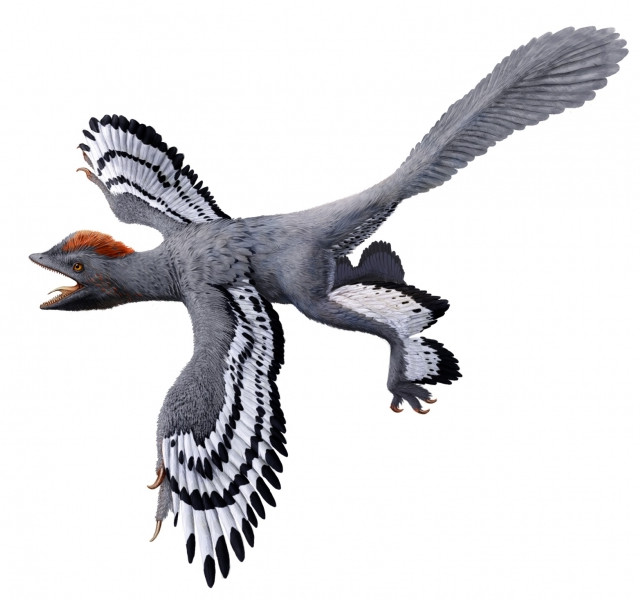
The image (Courtesy HKU MOOC / Julius T Csotonyi / Michael Pittman. All rights reserved) shows a reconstruction of an Anchiornis huxleyi, a small feathered dinosaur that lived about 160 million years ago in today’s China, based on evidence related to presence of melanin.
The researchers note that today there’s no formalized methodology for all cases of fossil color reconstruction and that the limits on the conservation of biological tissues with the problems related to their management must be kept in mind. Their proposal could help take a step forward in discovering the true colors of many prehistoric animals and better understand how they lived.
