
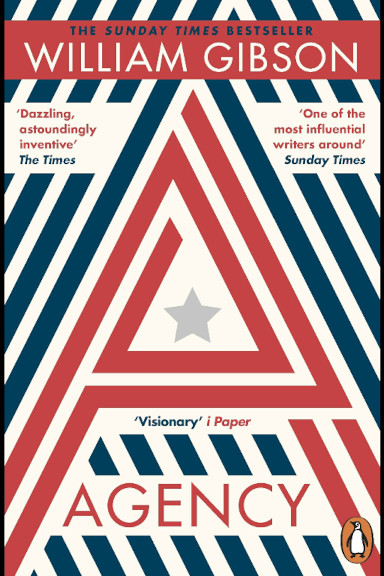
The novel “Agency” by William Gibson was published for the first time in 2020. It’s the second book in the Jackpot trilogy.
Verity is a beta testing expert and is hired to conduct a test of Eunice, an advanced model of digital assistant that appears to be included in specially built glasses. However, she finds it incredibly advanced, with characteristics that cause to her perplexities and fears.
Ainsley Lowbeer is working on a project connected to Verity and Eunice and her intervention in the past generates a new timeline. She tasks Wilf Netherton with intervening in that timeline, where some bad events were averted but the threat of atomic war remains.
In “The Peripheral“, William Gibson introduced a fictional universe between the present and the future that spans different timelines. People living in a post-apocalyptic future can communicate with their past but this generates a new timeline. In “Agency”, some protagonists who live in that future appear again while 2017 is a timeline that’s different from the one in the first book.
It’s not essential to have already read “The Peripheral” but it’s useful to already know the characters of the future and to understand the references to Flynne, the protagonist of that novel who lives in the present. That’s because “Agency” is a sequel in terms of the story of the characters from the future. The interactions between different eras and different timelines make the two novels complex and you must always keep in mind that in the 2017 depicted in “Agency” the Brits voted to remain in the European Union and the USA has a woman president.
Despite this complexity given by time ramifications, I found “Agency” relatively easy to read. The amount of dialogue, exposition, and repetition of concepts helps to understand what happens in Verity’s 2017 and post-Jackpot future. In some ways, “Agency” takes the structure of “The Peripheral” to the extreme in the parts composed mainly of dialogues which leave one suspecting that William Gibson could have cut some pages. If you’re looking for action, you might be disappointed because Verity’s moving around frankly seems like padding rather than action.
Much of “Agency” seems like an excuse used by William Gibson to offer food for thought on how important certain events in the history of humanity can be. In Verity’s timeline, a couple of critical events were averted but the danger of nuclear war remains. Thanks to technological advances, people in the so-called First World nations have all the possibilities to inform themselves and the problem is how they use them because a monkey with a smartphone is still a monkey.
The food for thought offered by “Agency” is based on typical contents of William Gibson’s stories including possible evolutions of current technologies and details connected to possible social evolutions of the near future. However, compared to his normal dark tones with dystopias where technology is used to exploit humans, this novel seems almost optimistic. To be clear, the author doesn’t offer very cheerful prospects but he does show a possibility that at least one timeline has a non-apocalyptic future.
Overall, “Agency” seemed to me to be what might be defined as a standard William Gibson novel, with his strengths and weaknesses. The length of the padding and supporting characters is perhaps greater than in any other novel by this author and this may discourage many readers. If you appreciated “The Peripheral”, you could still be satisfied by this new novel while waiting for the third novel in the Jackpot series. It’s available on Amazon USA, UK, and Canada.
