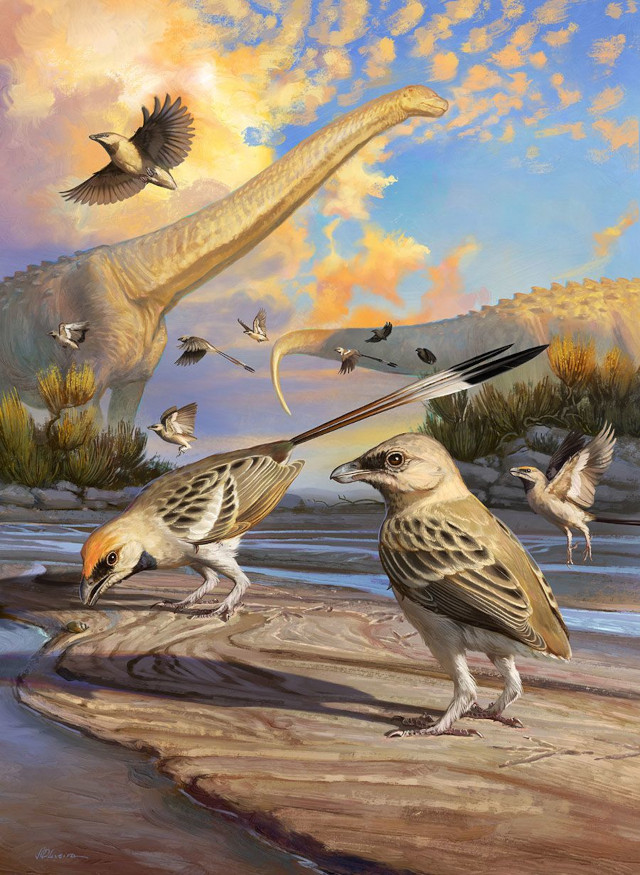
An article published in the journal “Nature” reports the identification of a species of primitive birds that lived about 80 million years ago, in the Cretaceous period, in today’s Brazil. A team of researchers examined a very well-preserved fossil skeleton and named the species Navaornis hestiae, attributing it to the group of Enantiornithes. A thorough examination was possible by subjecting the skeleton to a CT scan that allowed them to create a 3D reconstruction. The characteristics of the brain of this primitive bird offer new information on the evolution of bird brain.
Another fossil that includes only the basicranium described by researchers in an article published in September 2022 in the journal “Proceedings of the Royal Society B: Biological Sciences” shows morphological characteristics identical to those of the more complete fossil and for this reason, it was attributed to the species Navaornis hestiae.
Modern birds have some of the most advanced cognitive abilities in the animal kingdom. However, so far, it wasn’t possible to have enough information to reconstruct the evolution of those abilities. The available fossils left a gap between the famous Archaeopteryx, which lived about 150 million years ago, and modern birds. Archaeopteryx was a feathered dinosaur with a brain that still had a structure similar to that of non-avian dinosaurs.
Due to the fragmentary nature of the available fossils, there are discussions about the classification within the group of Enantiornithes, birds that lived in the Cretaceous period and got extinct later which had generally primitive characteristics. According to the reconstructions, there was a divergence between Enantiornithes and modern birds about 130 million years ago but there are still many questions about Enantiornithes, starting with their cognitive abilities. This study offers some very interesting answers.
The fossil of Navaornis hestiae was discovered in 2016 in the Adamantina Formation, in Brazil. The skull in particular is very well preserved, and this allowed the researchers to study it to understand the characteristics of this primitive bird’s brain. A CT scan made it possible to create a 3D reconstruction of its skull and therefore to understand which parts of its brain were developed.
The skull of Navaornis hestiae has superficial similarities with that of a pigeon but its detailed examination shows its differences from modern birds in general. Its characteristics place it halfway between Archaeopteryx and modern birds in terms of cognitive abilities.
The cerebrum of Navaornis hestiae was larger than that of Archaeopteryx, and this suggests that it had superior cognitive abilities to the early dinosaurs that were developing the characteristics that led to their evolution into birds. However, most brain areas were less developed, and this suggests that it hadn’t yet developed the complex flight control mechanisms of modern birds.
According to the researchers, the cognitive abilities of Navaornis hestiae may have given it an advantage in finding food or shelter. This bird may also have had complex social behaviors, including the ones connected to mating.
The researchers see the discovery of Navaornis hestiae as just the first step toward understanding the evolution of bird intelligence. The goal is to understand how this primitive bird interacted with its environment to gain insights that will provide a more precise picture of bird evolution.
A single well-preserved fossil skeleton provided a breakthrough. Discovering more fossils with a complete or nearly complete skull and conducting new in-depth examinations of known fossils using modern technology could lead to further breakthroughs.