
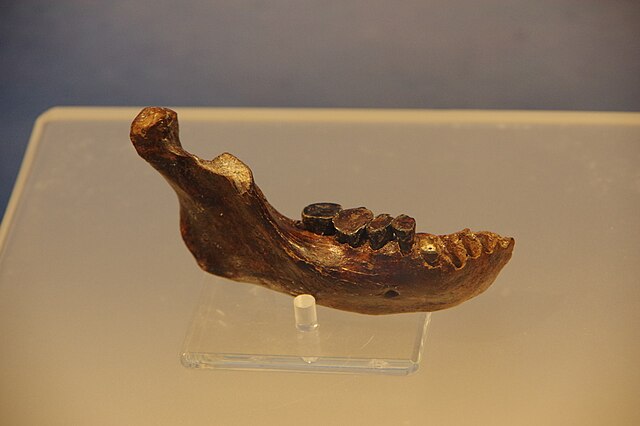
An article published in the journal “Science” reports the attribution of a fossil mandible (Photo courtesy TaichungJohnny) discovered in Taiwan to a Denisovan. A team of researchers conducted an analysis of amino acids still present in the mandible and in the enamel of the teeth still present, detecting two variants that were part of proteins specific to the Denisovan species. These are variants still present in some Asian populations that inherited genes from Denisovans. This discovery expands the area in which traces of this ancient human species have been found, a species that in some ways is still mysterious.
The mandible at the center of this study was classified as Penghu 1 because it was found by fishermen who were working in the Penghu Channel in Taiwan, near the Taiwan Strait that divides the island from mainland China. The history of this mandible is imprecise because it was sold to an antiques shop and in 2008 to a collector who later donated it to the Taiwan’s National Museum of Natural Science.
The attribution of the Penghu 1 mandible has been at the center of controversies because it’s an isolated bone that has characteristics similar to different species of the genus Homo. A 2015 study published in “Nature Communications” offered reflections on the difficulties of attribution and suggested that it was a new archaic human species. Now, however, a study of amino acids recovered from the mandible indicates that it belonged to a Denisovan.
The first fossils of a previously unknown hominin species were discovered in the Denisova Caves in the Altai Mountains in Siberia. Very few other fossils of this species have been found in the following years, but advances in genetic techniques allowed DNA fragments to be extracted from some bone fragments belonging to this species. The availability of DNA and smaller organic molecules such as proteins offers the means to identify other fossils.
The authors of this new study recovered 4,241 amino acid residues from the Penghu 1 mandible’s bone and dental enamel. They were compared with the structures of the proteins they form, and two of them were variants of proteins specific to Denisovans. The analysis also indicates that it was a man.
Amino acids have a stability that allows them to be preserved in fossils much longer than DNA, offering greater possibilities for analysis. In this case, protein analysis was combined with morphological exams that in the past already revealed similarities with the one also attributed to a Denisovan discovered in Tibet.
It wasn’t possible to proceed with a direct dating of the Penghu 1 mandible because the contamination due to the fact that it remained in sea water for millennia would distort the results. When that Denisovan man died, that area was on dry land, but the geological and hydrological changes that occurred over time offer very general indirect indications. The mandible is thought to be less than 450,000 years old, with an origin likely between 10,000 and 70,000 years ago or between 130,000 and 190,000 years ago. The circumstances of the discovery of this fossil make it impossible to have precise information, for example, to analyze the seabed layer in which it was deposited.
Despite the uncertainties and limitations due to the availability of only the mandible, the evidence of the presence of Denisovans in today’s Taiwan confirms that this human species was widespread in Asia. Each bone attributed to a Denisovan can provide new information important for reconstructing the history of a species still in many ways mysterious and its interbreeding with Homo sapiens.
