
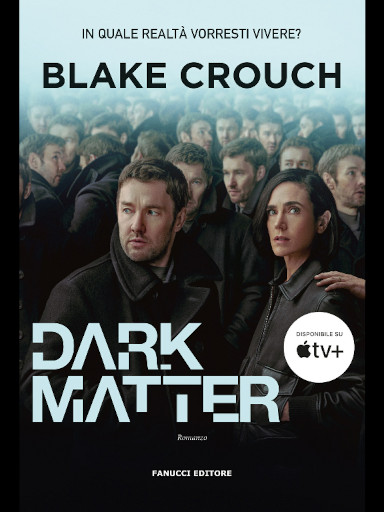
The novel “Dark Matter” by Blake Crouch was published for the first time in 2016.
Jason Dessen is about to return home to spend the evening with his wife Daniela and their son Charlie when he’s kidnapped by a mysterious man. Drugged and locked in a place he doesn’t know, he wakes up in a research facility where people tell him that he’s the only one who has returned.
Confused to say the least, Jason tries to understand why the people around him expect scientific revelations from him. Years ago, he had worked as a quantum physicist, but for a long time, he has been a university teacher. Even worse, he seems to be unmarried. He goes in search of Daniela, but the situation becomes dangerous.
What would our life be like if we had made different choices? This theme has been explored in many stories based on the existence of parallel universes. The many-worlds interpretation predicts the birth of new universes from every outcome of any event. “Dark Matter” uses this concept to tell the story of Jason Dessen, a teacher who occasionally wonders what his life would be like if he had continued to devote himself to research in the field of quantum physics.
For readers who are already familiar with this type of story, the first part of “Dark Matter” may seem too much based on clichés connected to characters who discover the existence of a multiverse. From a physicist who has conducted research in that field, one would expect him to quickly understand his situation. After the initial shock, also due to the drugs he was injected with, he later seems quite stubborn in thinking he has some health problem, physical or mental.
In this initial part, the frantic pace is a merit because you can read it very quickly. Blake Crouch uses a style full of paragraphs made of single short phrases that stress that pace but inevitably puts the action at the center. This is an advantage for readers who know nothing about quantum physics and have to read only a few very basic notes on the subject that were included because they’re useful to the plot.
In my opinion, the novel improves in the second half, when Blake Crouch explores the ramifications of the many-worlds interpretation. A plot that was linear becomes, so to speak, kaleidoscopic, and for Jason Dessen, the situation becomes decidedly more complex. Another step forward is given by the fact that the initial confusion of the protagonist is replaced by a progressive attempt to plan his attempts to return to his timeline.
Jason Dessen’s mental state is another central element in this novel. Even in the initial days of confusion, his priority is to return to his wife Daniela and their son Charlie. For this reason, the moments that are most devastating for him from a mental point of view are the ones in which he clashes with a reality that is very different from his own, especially concerning his relationship with Daniela.
For these characteristics, “Dark Matter” is a novel that can be read at a remarkable speed, in a time in which one would normally read a novel half as long as this one. It’s based on action and the protagonist’s emotions and feelings, and this makes it easy to appreciate for those who normally don’t read science fiction. For this reason, I’m not surprised that they adapted it into a TV show. I haven’t watched it, so I can’t comment on it. I recommend reading this novel to people interested in this type of story. It’s available on Amazon USA, UK, and Canada.
