
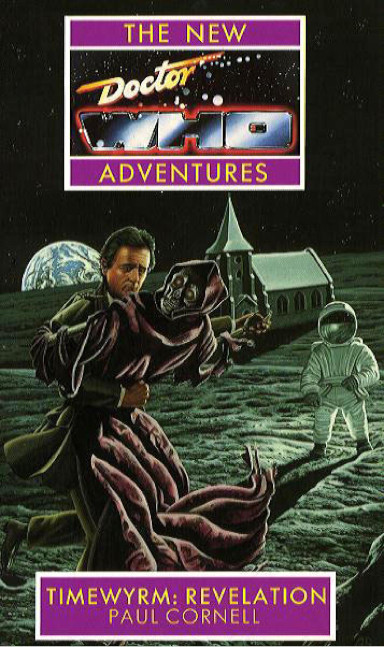
The novel “Timewyrm: Revelation” by Paul Cornell was published for the first time in 1991. It’s No. 4 in the “New Adventures” range by Virgin Publishing.
The Seventh Doctor has lost track of the Timewyrm and heads the TARDIS to the village of Cheldon Bonniface, in the late 19th century, where an old acquaintance lives. While the Doctor is playing chess, Ace is attacked by a small astronaut and, fleeing, soon realizes she has ended up on the surface of the Moon, where she suffocates.
Reality also shifts for the Doctor, who realizes that what looked like his friend is actually Hemmings, whom he met in the timeline where the Nazis won World War II. Returning to the TARDIS, he discovers he’s on the Moon in 1992. What’s real?
“Timewyrm: Revelation” concludes the mini-cycle that inaugurates this series of books from Virgin Publishing, which continues the Doctor’s adventures after the classic “Doctor Who” series was cancelled. It picks up that story after the events of “Timewyrm: Apocalypse“. Like the previous books, it contains several references to the classic series, including appearances by old Doctors.
Paul Cornell was a young writer who, among other things, had written “Doctor Who” fan fiction. He took the idea behind one of those fan fictions and developed it into a novel, adapting it to conclude the Timewyrm’s story.
In the classic “Doctor Who” series, there were occasional serials in which the Doctor and his companions ended up in strange dimensions ruled by entities that proved unfriendly. At least on the surface, this is also the case in “Timewyrm: Revelation,” where the Seventh Doctor and Ace end up in a trap.
For a Doctor who often behaves like a manipulator, it’s difficult to face an adversary who can manipulate what, at least on the surface, is reality. At any moment in this conflict, it’s almost impossible to say whether something is real, unreal, surreal, or otherwise. Of course, if the Doctor dies, the suspicion arises that it didn’t actually happen, but in general, the reader may have doubts about what’s actually happening.
In Ace’s case, the situation is essentially the same. Paul Cornell uses her story to delve into her past even further than was the case in the television series. It’s safe to say that Ace has her own adversary to face, as she encounters Chad Boyle, an old schoolmate and a bully who tormented her and, in this novel, kills her a couple of times.
Due to the sort of fragmented reality in which most of the novel is set, the story doesn’t have a real pace. If anything, you could say that it’s a heterogeneous collection of very short stories with constant shifts in tone and setting. These kaleidoscopic fragments give the novel a surreal and sometimes dreamlike tone, with the latter often to be interpreted in the sense of a nightmare.
The events the Doctor and Ace experience lead, among other things, to a delve into their minds. In the television series, there was little room for ethical and moral considerations surrounding the Doctor’s actions and their consequences, but Paul Cornell offers us a glimpse of them. This exploration also includes the complexity of the relationship between the two protagonists. This is perhaps the novel’s greatest strength, especially since the author reprises their stories so well from the classic series.
The Timewyrm is behind all this, and that’s clear from the beginning. However, if another entity had been the adversary, little would have changed. For this reason, if you hadn’t read the previous books, you’d have lost little, even though the character of Hemmings from the alternate timeline reappears.
In the end, throughout the mini-cycle, it seems that the Timewyrm was used as an excuse to create dangerous situations for the Doctor and Ace, but they aren’t a great character. This is another reason why the stories in this mini-cycle vary greatly in quality, but at least the ending in “Timewyrm: Revelation” is good. Today, it may be of interest to fans curious about those stories. You might find a copy at Amazon USA, UK, and Canada.
