
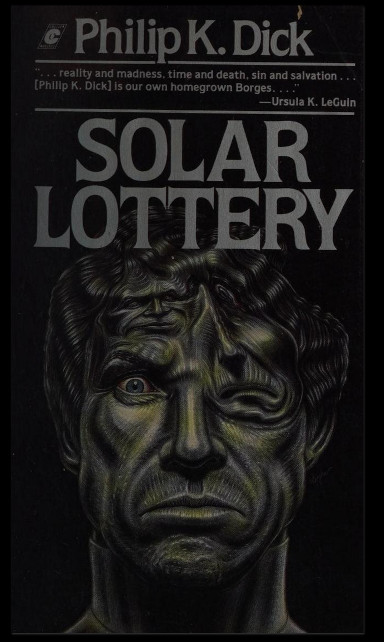
The novel “Solar Lottery” by Philip K. Dick was published for the first time in 1955.
When Ted Bentley is fired from the Oiseau-Lyre, he’s released from his oath of loyalty to the corporation. When he manages to get a job at the Directorate and pledges loyalty to Reese Verrick, he thinks he’s accomplished something because Verrick is the Quizmaster. However, a new draw has awarded the position of Quizmaster to Leon Cartwright, and this upends the government of humanity.
By law, the new Quizmaster must prepare defenses against the assassin, who will be chosen according to the established rules. The situation is even more complex because Leon Cartwright follows the ideas of John Preston, who wrote a book predicting the existence of a tenth planet, the mythical Flame Disc.
In the early 1950s, Philip K. Dick was trying to establish himself as a writer. He published his first science fiction stories, but not other non-genre works. In 1955, he finally published “Solar Lottery” after the publisher asked him to revise the first version. A different version was published in the United Kingdom under the title “World of Chance.”
“Solar Lottery” introduces a future in which the offices of humanity’s unified government are decided by a lottery. The system is led by the Quizmaster, who is consequently the most powerful of humans. An assassin is chosen to test the Quizmaster’s abilities.
The system is seemingly democratic because it offers all citizens the chance to be selected as a Quizmaster. Many people rely on lucky charms in the hope of being selected. In reality, throughout the novel, we see that citizens are classified according to their profession, a veritable caste system managed by multinational corporations.
The change in leadership at the beginning of the novel and its consequences are used by Philip K. Dick to criticize the society that was already emerging in those years, particularly the growing power of big corporations. The apparent modernity depicted in the novel conceals a system that is in fact feudal, in which employees swear loyalty to their employer.
The power struggle is fought relentlessly in a system where assassinating the Quizmaster is legal. Philip K. Dick includes other elements that became typical of his works, such as the presence of telepaths and androids, used in this novel to defend and attack the Quizmaster, respectively.
Perhaps the changes requested by the publisher altered some of the plot’s development, and perhaps Philip K. Dick was still learning how to manage a novel-length story, but “Solar Lottery” ends up being quite chaotic. One should read the various published versions and the author’s first draft to understand the origins of the flaws.
The version considered final of the novel contains many ideas, but they’re mixed together in an uneven way, and some aren’t developed as they should be. The parts connected to the lottery system have considerable potential in criticizing the power of big corporations, but they could have been much punchier. The plot section about the Flame Disc is forgotten in a big part of the story. In short, you can see Philip K. Dick’s talent, but also the chaos in his approach to developing his novels.
Many years after its publication, Philip K. Dick stated that “Solar Lottery” was his best-selling novel. In the 1970s, this was possible because, despite its flaws, it’s an enjoyable novel with a story full of twists and turns told at a fast pace. The world dominated by big corporations seems even more relevant decades later, which is another reason why I think it’s still worth reading. You can find it on Amazon USA, UK, and Canada.
