
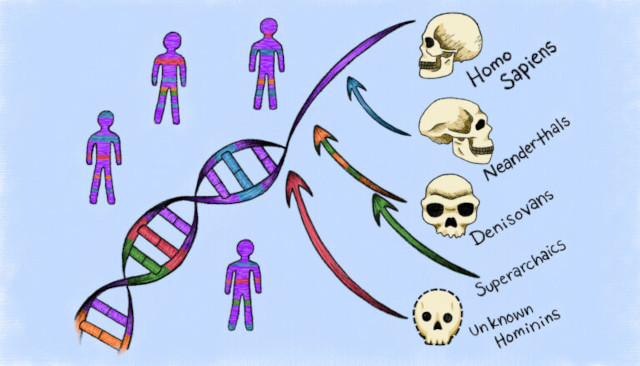
An article published in the journal “Science” reports the discovery of genes belonging to two previously unknown hominin species in the DNA of modern humans. A team of researchers led by the University of California, Berkeley used a new algorithm called TRACE (TRacking Archaic Contributions via ARG Estimation), which they developed to reconstruct genetic relationships among hundreds of living human genomes. This allowed them to recognize two archaic genetic components from hominins that interbred with Homo sapiens in Africa over 50,000 years ago, and another from an interbreeding that occurred approximately 1.8 million years ago. The super-archaic genes of the second group don’t derive from a different interbreeding with modern humans, but from an interbreeding with the Denisovans.
The image (Courtesy Meaghan Marohn. All rights reserved) shows an illustration indicating the hominins that have left genetic traces in the DNA of modern humans.
Genetic research conducted in recent decades on modern humans and paleogenetic research conducted on ancient bones that still contained DNA have increasingly shown how human history has been marked by interbreeding between different populations and migrations. The DNA of modern humans contains varying amounts of genes from Neanderthals and Denisovans, the ancient humans unknown until less than twenty years ago.
The scarcity of ancient genomes makes these studies difficult, but analyses of modern genomes are showing that so-called ghost genes, inherited from hominins of unidentified species, also exist. One example is the study published in February 2020 in the journal “Science Advances,” which indicated that the DNA of some West African populations contains genes from mysterious hominins. This new study has identified two groups of archaic ghost genes.
These ghost gene studies are based on the reconstruction of what are called ancestral recombination graphs (ARGs). Over the years, some algorithms have been developed to perform this type of reconstruction, and the one called TRACE was developed to only require analyses of modern genomes.
The first ghost lineage indicates that over 50,000 years ago, there was interbreeding between Homo sapiens and another hominin species. These ghost genes suggest that those hominins split from the genetic lineage that gave rise to modern humans around the same time Neanderthals and Denisovans diverged. On average, modern humans have 1% of their genome composed of these ghost genes.
The second ghost lineage is really super-archaic, referring to an interbreeding that occurred approximately 1.8 million years ago. These genes were inherited by Denisovans somewhere in Eurasia and spread to Homo sapiens when these two human species interbred. Today, Oceanian populations contain the greatest amount of Denisovan genes, as well as those of these unknown super-archaic genes.
Many of the archaic genetic sequences are tied to immunity and metabolism. This suggests that they were preserved because they provided ancient hominins with adaptations useful for living in environments such as very cold ones and for resisting certain diseases.
This study represents a step forward in reconstructing the complex history of humanity, but the researchers have listed some questions that still remain unanswered. Future studies could lead to further progress by including not only other modern human genomes but also those obtained from Denisovan bones and even proteins obtained from Homo erectus bones. Genetic algorithms like TRACE are becoming increasingly sophisticated and are aiding these studies.
