
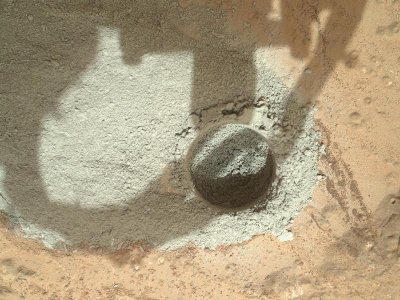
The Mars Rover Curiosity has been on Mars for several months but only now it made its first drilling test. For this test it used the drill mounted on its robotic arm to dig a hole in a rock named John Klein after an engineer of the project Curiosity who passed away in 2011.
The hole drilled in this test is very small, being only a couple of centimeters (0.8 inches) deep and its diameter is even a little less, about 1.6 cm (about 0.6 inches). On the other hand, the Mars Rover Curiosity drill isn’t very big and isn’t designed to dig deep but only up to about 5 cm. Its purpose is to take samples of interesting rocks for further analysis using the instruments that form a real moving chemical laboratory.
The John Klein rock was chosen among other things because the observations made before the drill gave indication of the presence of a wet environment in the past. One of the main purposes of the missions to Mars is exactly to understand what were the conditions on the red planet in the past. For a long time we’ve known that in its early days it was more similar to the Earth, now scientists are trying to reconstruct its history also analyzing its soil.
The drill test was accomplished step by step, first testing the drill briefly, then with the “mini-drills” that produced a ring of dust. This was an actual drill, though not to the greatest possible depth. The Mars Hand Lens Imager (Mahli), one of the cameras of the Mars Rover Curiosity mounted on its robotic arm, recorded this activity.
Now the team that runs the Mars Rover Curiosity operations will analyze the photographs taken to assess whether the drill operation was adequate or it’s necessary to proceed with other tests using it in a different way. If the test will be judged positive, Curiosity will proceed with a complete drill task.
The intention is currently to drill again on John Klein rock. The hope is to understand, also using other instruments of the Mars Rover Curiosity, if the Gale Crater area has offered in the past favorable conditions for the development of life on Mars.
[ad name=”GANGeeks.com468″]
