
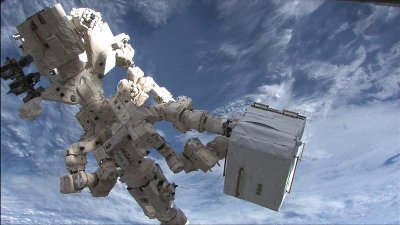
NASA and the Canadian Space Agency (CSA) announced the success of a key test of the Robotic Refueling Mission (RRM) in which the robot Dextre, also known as Dexterous Special Purpose Manipulator (SPDM), simulated the resupply of a satellite in geosynchronous orbit.
The robot Dextre was designed jointly by NASA and CSA in order to make a leap forward in the maintenance of satellites in orbit. Brought to the International Space Station in July 2011 by the Space Shuttle Atlantis, it’s going through a long and complex series of tests.
The Dextre robot is mounted on the end of the robotic arm Canadarm2 and through four instruments that can cut and manipulate wires, unscrew caps, open and close valves and transfer fluids. The crew of the International Space Station may check its work using cameras that provide them with a close-up view of what’s going on.
Last year there was a first test simulated the early stages of a satellite resupply to make sure that the instruments could operate with the necessary precision. On January 14, 2013 a test started that simulated a complete resupply. Inevitably, in these cases there may be problems and after one day the test was stopped due to what turned out to be a problem with the control software of the robot Dextre.
On 22 January, it was possible to resume the test of the Robotic Refueling Mission, which was completed with a positive result. The transfer of fluids in space is a particularly delicate operation that requires considerable precision. In general, satellites aren’t built to be resupplied so the robot Dextre must break the tank seals, adding a difficulty to the task.
So far, the depletion of the propellant generally marked the end of life of a satellite, whose orbit couldn’t be adjusted anymore so it became a hazardous waste and eventually fell down to Earth. The Robotic Refueling Mission aims to change this state of affairs leading to significant savings because resupplying a satellite whose instruments are still working will probably cost several million dollars but building a new one and putting it into orbit is much more expensive.
The Satellite Servicing Capabilities Office (SSCO), created by NASA in 2009 in order to develop those robotic technologies, will soon present the detailed results of the Robotic Refueling Mission. Meanwhile, NASA started exploring the possibility of collaboration with private companies to offer this type of services.
New tests are planned to expand the possibilities of use of the Dextre robot to also perform repairs and other services on satellites. If we think of how important satellites have become for communications, for the control of the territory and for many other purposes, it will be a major step forward.
[ad name=”GANGeeks.com468″]
