
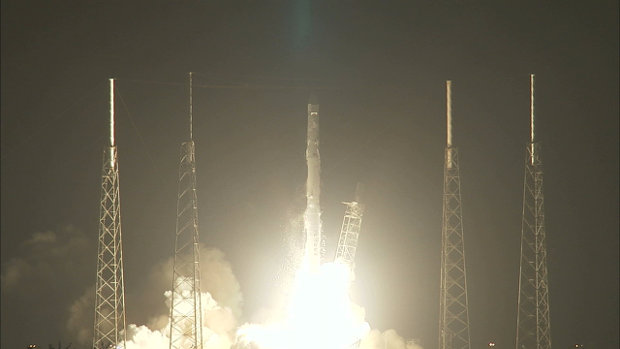
A little while ago the SpaceX Dragon spacecraft blasted off on a Falcon 9 rocket from Cape Canaveral in its CRS-4 (Cargo Resupply Service 4) mission, also referred to as SPX-4. This is the fourth of 12 missions that for the Dragon spacecraft to the International Space Station with a cargo and its return to Earth, again with a cargo.
On September 7, SpaceX launched the commercial telecommunications satellite AsiaSat 6. For the company is the shortest time between two launches. On July 13 and August 5 here were two other satellite launches so this became the fourth launch for SpaceX within little more than two months.
With the Falcon 9 rocket version 1.1 a new technology for the controlled landing of the first stage is being tested. However, in this case it’s not equipped with legs in carbon fiber and SpaceX hasn’t communicated the reasons for this choice.
The cargo of the Dragon spacecraft is over 2.2 tonnes (almost 5,000 pounds) between the pressurized and non-pressurized sections. There are more than 600 kg (almost 1,400 pounds) of food and other supplies for the crew of the International Space Station but most of the cargo consists of instruments, hardware and various other materials needed for 255 scientific experiments and research conducted aboard the Station.
One of the main instruments carried by the Dragon spacecraft is the first 3D printer to fly in space. This is an experiment to demonstrate 3D printing technology in the absence of gravity. This system uses acrylonitrile-butadiene-styrene (ABS), a thermoplastic polymer already used to create objects that are lightweight and rigid at the same time.
In this case, the ABS will be used by the 3D printer to check the possibility of creating useful objects in the Station. It’s a technology with an enormous potential for space missions because it would be necessary to send into space only the material for printing. In the future, the idea is to use existing materials on the Moon, Mars or on asteroids to create what may be needed by astronauts and also colonists with 3D printers.
Another instrument carried by the Dragon is Arkyd 3, a nanosatellite consists of 3 CubeSat units built by Planetary Resources. It has the purpose of experimenting the technology of the Arkyd-100 space telescope, currently in its prototype stage. It will be launched from the International Space Station to test its systems.
The cargo includes other instruments and experimental satellites such as SPINSAT (Special Purpose Inexpensive Satellite), a ball with the diameter of about 56 cm (22 inches) that has the goal of testing the Electric Solid Propellant (ESP) technology in space. Its mini-thrusters can provide a boost that can be controlled safely in a very precise way.
This version of the Dragon spacecraft isn’t designed to carry a crew but in the pressurized section there’s also a group of mice. Some of them are normal mice, others are transgenic mice. Living on the International Space Station, it will be possible to study their muscle loss and especially the differences between normal and transgenic mice.
The Dragon spacecraft is now en route to the International Space Station and everything proceeds normally. The arrival is scheduled for Tuesday: shortly after 11 AM UTC it should be captured by the Station’s robotic arm.
[ad name=”AmazonScience”]

Permalink
Permalink