
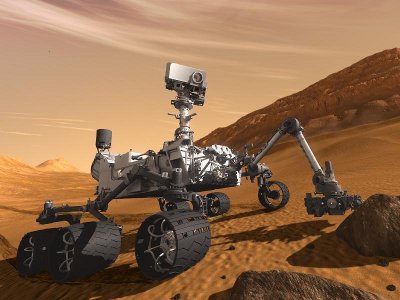
Pacific Gas and Electric Company (PG&E) is a subsidiary of PG&E Corporation and is a major natural gas utility in the USA. The company is now testing a new device for the detection of methane leaks based on an instrument of the Mars Rover Curiosity. Developed to find out if there is methane on Mars, a possible trace of biochemical reactions, this instrument is a thousand times more sensitive than those used so far by PG&E to detect leaks of methane.
PG&E handles approximately 77,000 kilometers (48,000 miles) of pipelines that distribute natural gas around the USA with the consequent problems of maintenance. Methane, which is the main ingredient of natural gas is odorless but it’s added smelly compunds exactly to allow people to realize if there’s a gas leak in their home or at least nearby. The pipes that carry gas must instead be controlled by specific staff with appropriate instruments.
PG&E uses instruments carried on various vehicles on land, sea and even air. It’s not only about avoiding leaks that can be dangerous but also other more limited ones that cause small but steady gas leakage into the atmosphere. It’s not only an economic issue but there are also national and state laws that require careful monitoring. Methane is a greenhouse gas that has much greater effects than carbon dioxide in retaining solar heat so it’s really important to limit as much as possible its leaks.
[ad name=”AmazonDocumentary”]
The Mars Rover Curiosity is equipped with a suite of instruments called Sample Analysis at Mars (SAM) that can analyze organic materials and gases in the atmosphere and in solid samples. Among the instruments that make up the SAM there’s the Tunable Laser Spectrometer (TLS), which has the purpose to perform precision measurements including those of methane in Mars atmosphere.
This laser spectrometer was adapted to the requirements of PG&E to build one that is lightweight and easy handling by the staff. It’s used with a simple tablet-based interface that shows the measurements made by the instrument. The company plans to deploy more of those instruments in 2015, after the test phase.
The result is that no it’s possible to check more easily the pipelines and quickly find the source of gas leaks. This increases the safety of the natural gas distribution and helps the environment. Again, a technology developed for a space mission was adapted for an important use on Earth.

