
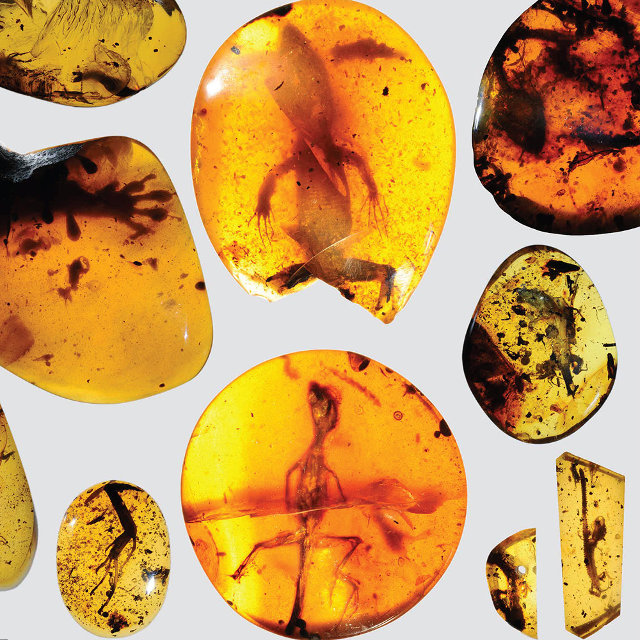
An article published in the journal “Science Advances” describes the exams carried out on the remains of lizards and a primitive chameleon exceptionally preserved in amber. There’s a total of 12 specimens of which a geko, an archaic lizard and the chameleon were particularly well preserved. There are missing links in the history of these species so they’re providing new information on the evolution of these animals.
These specimens were discovered many years ago but for a long time were part of a private collection. The owner donated them to the American Museum of Natural History, where Edward Stanley of the University of Florida found them and started examining them with modern instruments. In fact he used micro-CT equipment in order to perform scans inside the amber blocks without damaging the fossils.
The scans identified what is by far the oldest chameleon found so far with an estimated age of nearly 100 million years, 78 million years older than the specimen that held the previous record. It’s not the first time that fossils are found preserved in amber but in the case of animals larger than insects generally there are just some parts but in this case there are some complete specimens.
The examined animals are really small, around a centimeter (about half an inch) in length, an advantage for paleontology because they were fully enveloped in the resin that became amber. Lizards so small, with very delicate skin and fragile bones, don’t fossilize well. The consequence is that the reconstruction of their history and that of chameleons are based on many assumptions based on limited information. This makes these specimens preserved in amber very important.
The examis of these animals revealed not only intact limbs but a truly extraordinary level of conservation, up to the their scales’ color. Edward Stanley called it a window in the tropical life of the mid-Cretaceous. It’s a critical period for the diversification of various species with missing links in their history.
Ptudying previous genetic analyzes, paleontologists speculated that the chameleons had originated from a family of lizards called agamidae in the mid-Cretaceous but there were no fossils that could support that idea. According to Edward Stanley, the discovery of this primitive chameleon suggests that the origin of these animals is more ancient and didn’t happen in Africa as previously thought.
This is really is a major discovery to better understand the history of various reptiles and modern technologies allow to carry out detailed exams without damaging the specimens. It takes luck to find such extraordinary fossils but technological advances are really helping paleontology allowing exams that were unthinkable not many years ago.
