
An article published in the journal “Scientific Reports” describes the study of a fossil of Teyujagua paradoxa, a reptile lived at the beginning of the Triassic, about 250 million years ago. A well-preserved skull was found at the beginning of 2015 near the city of São Francisco de Assis, in southern Brazil. According to the members of the international team that studied it, this discovery represents a help in understanding the evolution of the group of animals called archosauriforms (Archosauriformes), which includes dinosaurs, pterosaurs and crocodiles but also birds.
Teyujagua paradoxa lived immediately after the devastating extinction at the end of the Permian period eliminated about 90% of existing species and is a species emerged with the recovering of the world’s ecosystems after the catastrophe. Probably it was caused by a long and intense volcanic activity in today’s Siberia, which made environmental conditions almost impossible for life.
When the environmental situation improved, the small populations of survivors had the opportunity to expand and diversify occupying empty niches. The consequence was that at the beginning of the Triassic, the geological period that followed the great extinction, various groups of animals became dominant, starting with dinosaurs and in general of archosauriforms. However, the origins of this diversified group of animals are obscure and any fossils of yet unknown species can be of great help.
The skull of the reptile called Teyujagua paradoxa by its discoverers is considered very important from this point of view because it has anatomical features intermediate between those of more primitive reptiles that lived previously and those of archosauriforms that evolved later.
Teyujagua paradoxa was a small reptile that probably looked pretty much like a crocodile. According to estimates, its specimens could reach a length of about 1.5 meters (abour 5′). It was the type of animal that lived on lakes and rivers shores feeding on amphibians and other reptiles of the time such as procolophonids (Procolophonoidea).
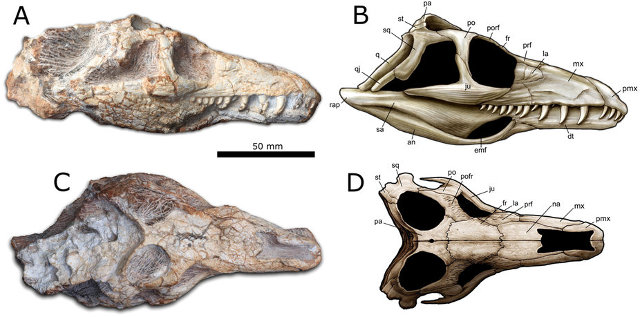
Various indications on the evolution of the archosauriforms’ head was provided by the skull of Teyujagua paradoxa, whose image shows the fossil from the right side (A and B) and the dorsal view (C and D) in photographs and interpretive drawings by J. Anderson.
Excavations in the area where the Teyujagua paradoxa fossil was found continue and other fossils have been found. Paleontologists are studying them and will keep on searching hoping to discover other parts of this species’ body and possibly other reptiles of that time.
