
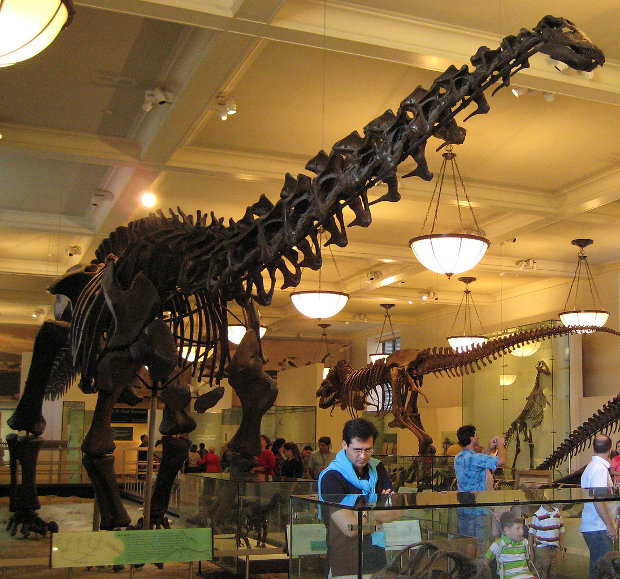
An article published in the journal “Royal Society Open Science” describes a research that provides an explanation of the evolution of sauropod dinosaurs, the ones that become the biggest such as the famous brontosaurus (photo ©Elika & Shannon). A team of paleontologists led by Dr. Karl Bates from the University of Liverpool developed computer models of their bodies to examine the evolution of their shapes.
Sauropods are a group of herbivorous dinosaurs that reached very large sizes, so much that some of them became the largest land-dwelling animals ever. They shared certain physical characteristics such as the fact that they were quadrupeds with very small heads and long tails.
Of some species, there are only very fragmentary fossils so their sizes have been estimated based on certain characteristics and are still controversial, as well as their classification. If the estimates are correct some species may have been the largest animals ever lived, even more of the most massive whales.
These typical characteristics of sauropods were the result of several changes in the course of their evolution. In fact, they descended from more primitive dinosaurs more similar to their theropod cousins, much smaller and bipeds with small forelimbs. To be clear, carnivorous dinosaurs such as tyrannosaurs were theropods. So far no studies were conducted to analyze the evolutionary changes that turned animals with certain characteristics into others with significantly different characteristics.
Dr. Karl Bates works for the University of Liverpool’s Department of Musculoskeletal Biology and along with his co-workers used three-dimensional computer models to reconstruct the bodies of sauropod dinosaurs. That allowed the team to analyze the evolution of their size, shape and distribution of weight over time.
Early sauropods appeared in the late Triassic period but only during the late Jurassic differentiated for the first time to give life to some families that spread around the world. Later, in the early Cretaceous, the new species emerged belonging to the group of titanosaurs (Titanosauria) which, despite their name, were not all gigantic.
The models created show that the changes in sauropods’ body shape coincides with crucial events in their evolutionary history, such as the rise of titanosaurs. The primitive dinosaurs from which they descend had their weight concentrated at the hip joint but the evolution of sauropods led the distribution of their weight to move forward.
The size of sauropods increased gradually and at the same time they became quadrupeds ending up with the typical shapes of the Jurassic species such as the brontosaurus or the diplodocus. Their developments didn’t stop and in the Cretaceous many groups of sauropods disappeared but titanosaurs emerged with physical characteristics that were taken to the extreme with larger and larger necks.
These conclusions contain a degree of uncertainty due to the fact that some data are the result of estimates. Skeletons that are complete or almost complete of many species were found but the amount of meat around their bones isn’t certain. The models were created keeping in mind this problem and considering various possibilities their evolutionary trends are the same. Models can be improved but certainly this research provides an important basis.
