
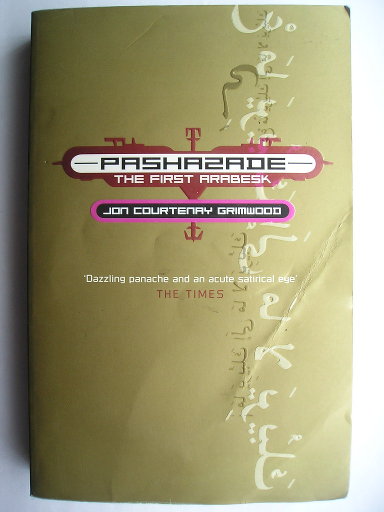
The novel “Pashazade” by Jon Courtenay Grimwood was published for the first time in 2001. It’s the first novel in the Arabesk trilogy.
The life of Ashraf al-Mansur called Raf or ZeeZee changes when a woman claiming to be his aunt tells him that his real father is the Emir of Tunis and helps him get out of the prison where he was locked up for murder. When he arrives in El Iskandryia (Alexandria of Egypt), in the Ottoman Empire, where he reaches Nafisa, his alleged aunt, he finds himself with the prospect of an arranged marriage with Zara, a girl never seen.
Overall, the outlook for Raf’s future is good but he calls off his wedding to Zara and a few days later Nafisa is murdered and he’s among the suspects. Forced to take care of Hani, a niece he somehow “inherited” from Nafisa, Raf must handle himself among the power play and the secrets he discovers in the city to understand what’s behind the murder.
Jon Courtenay Grimwood is an author who writes stories of various genres, from science fiction to fantasy and thrillers. A number of his works are set in ucronias set in alternative histories with different points of divergence from ours. In the Arabesk trilogy the war that broke out in 1914 didn’t turn into World War I but ended in 1915.
One of the consequences of the limited war is that Germany remained a great power and the Ottoman Empire never collapsed. However, in many ways this alternate world is very similar to ours, so much that many brands existing in our world are mentioned.
Among the Ottoman Empire provinces there’s Egypt and in the city of Alexandria, called El Iskandryia, the plot of “Pashazade” is developed. The novel begins with the arrival of Ashraf al-Mansur after it was pulled out of jail by Nafisa, a wealthy woman who lives in the city.
The story of Ashraf al-Mansur, also known as Raf or ZeeZee, is central in “Pashazade” because the man is at the center of a complex plot and various chapters of the novel tell flashbacks about his past and in particular his youth. They allow the reader to understand something of the protagonist such as his complicated family and the enhancements he received through biotechnology.
The plot of “Pashazade” is complicated by both the main story set in El Iskandryia and the flashback about Raf’s past, so much that even at the end he’s still a character for in some ways obscure. The man had just found some relatives he didn’t know when he gets entangled in a dangerous intrigue but the experiences he lived allow him to handle himself among the various dangers in a city he doesn’t know.
I have to say that I was only partially satisfied by “Pashazade”. It’s a novel that seeks to bring together various genres since it’s a thriller set in a ucronic world but I think it’s not entirely successful. Some labels attached to it don’t help.
For example, in a ucronia I expect the author to add many details about the differences between the alternative world and ours. In “Pashazade” there’s the Ottoman Empire with a significant presence of German characters but otherwise it’s often really familiar. In short, I’d have expected a greater divergence.
As a thriller, in my opinion “Pashazade” suffers from the fact that in the end the villain didn’t seem very interesting to me, with trivial motives. It’s often true that evil is dull but in such a complex a novel I expected more. In general I found that some of the characters are well developed but others are a bit dull.
I saw “Pashazade” labeled as cyberpunk but such a description is better suited to the Budayeen series by George Alec Effinger, which perhaps was an inspiration for Jon Courtenay Grimwood. Raf also comes with various implants but otherwise the biggest cyberpunk thing of the novel are characters who use a computer running Linux.
In the end, maybe “Pashazade” is too complex for the novel’s length. In all this the most successful element and therefore the most interesting one is the protagonist. His personal multi-faceted story is the strength of this work which is also in some way a man redeeming himself after losing himself in the course of his life.
It’s for these reasons that, despite its flaws, I think that “Pashazade” is still a good novel. If you’re interested in its themes you’ll probably like. In your evaluation, I advise you not to think too much about the labels that were attached to the novel because they’re limiting if not misleading.

Permalink