
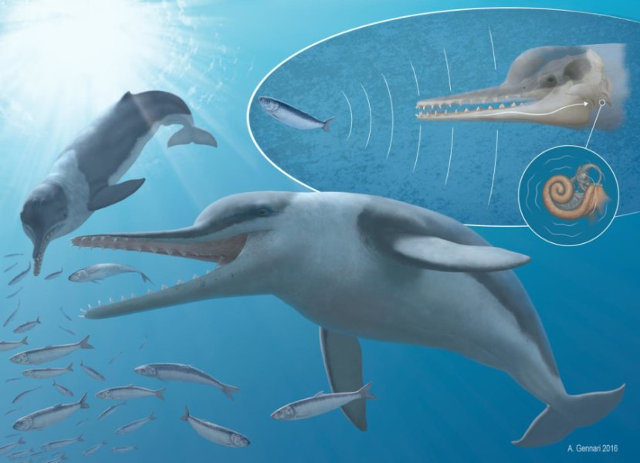
An article published in the journal “Current Biology” describes a research on an ancient cetacean called Echovenator sandersi that shows how these marine mammals’ ultrasonic hearing is very ancient. A team of scientists led by Morgan Churchill of New York Institute of Technology in Old Westbury, New York, used modern scanning techniques to analyze the very well preserved ear of a fossil dating from the Oligocene period.
Today’s toothed whales (Odontoceti) use echolocation systems to navigate and hunt underwater. The ability to perceive high frequency sounds is very useful in these cases it wasn’t clear when it had emerged in ancient cetaceans.
The discovery in 2001 of a fossil in South Carolina classified as part of the toothed whale group and in particular the Xenorophidae family offers some more information. The specimen of this whale that was called Echovenator sandersi was discovered fossilized in an extraordinarily complete way and this allowed to conduct in-depth exams of its ear.
The researchers performed a CT scan to the Echovenator sandersi’s skull and compared it with that of two hippos and 23 whales both fossil and living ones. The results suggest that the ability to hear high-frequency sounds evolved in these cetaceans about 27 million years ago.
The researchers concluded that the traits associated with this ultrasonic hearing are actually previous to the evolution of toothed whales, which means that whales’ high frequency hearing evolved earlier than previously thought. Another major finding from the analysis is that probably the ancestors of toothed whales could hear up to higher frequencies than their relatives that lived on the mainland.
The Echovenator sandersi’s inner ear is surprisingly similar to that of modern whales and only one of its traits was more similar to those of ancient whales than to those of modern whales. This suggests a very rapid evolution of hearing in primitive whales. Many characteristics can also be found in modern dolphins, with which this ancient cetacean is related.
Echovenator sandersi is just one of the many fossils of cetaceans found in today’s South Carolina. Those are some of the most ancient ancestors of toothed whales and Morgan Churchill and his colleagues are studying them to reconstruct the history of whales and the evolution of the characteristics of the various species of this family.
