Paleontology

An article published in the journal “Nature” describes a research that confirms that the ancient animal commonly known as “Tully monster” was a vertebrate. Decades after the discovery of the first fossil of Tullimonstrum gregarium – this is its scientific name – and a number of hypotheses about its classification, this study is the second in a few weeks published in “Nature” to reach the same conclusions.

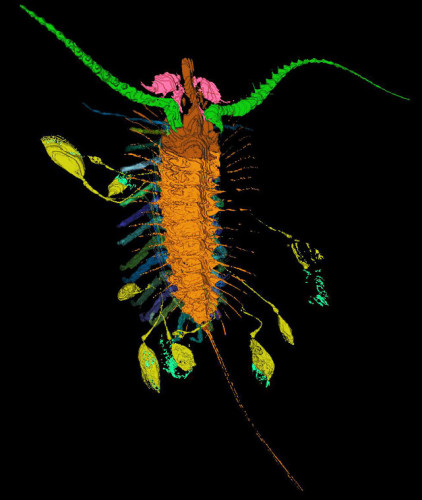
Aquilonifer spinosus reconstruction (Image Derek Briggs)

An article published in the journal “Proceedings of the National Academy of Sciences” describes the discovery of an arthropod that lived about 430 million years ago. It was named Aquilonifer spinosus, where the genus name means “kite”, a name inspired by the movie “The Kite Runner” because it was carrying its juveniles attached to its body as if they were tiny kites.

Different views of Idmonarachne Brasieri scans (Image Russell J. Garwood et al.)

An article published in the journal “Proceedings of the Royal Society B: Biological Sciences” describes the discovery of a fossil of a arachnid dating back some 305 million years ago. Named Idmonarachne brasieri, it shows similarities with modern spiders and its exam could provide a lot of information on the evolution of these animals, known to a limited extent because of the scarcity of fossils of their ancestors.

An article published in the journal “Royal Society Open Science” describes a research that provides an explanation of the evolution of sauropod dinosaurs, the ones that become the biggest such as the famous brontosaurus. A team of paleontologists led by Dr. Karl Bates from the University of Liverpool developed computer models of their bodies to examine the evolution of their shapes.

a-h Chinggiskhaania bifurcata fossils, i-j Zuunartsphyton delicatum fossils (Image Stephen Dornbos et al.)

An article published in the journal “Scientific Reports” describes the discovery of two species of algae dated over 555 million years ago, during the period known as the Ediacaran. These are some of the oldest multicellular life forms ever found and their fossils are very rare because those soft bodies are difficult to preserve. For this reason each new discovery provides new information on the development of multicellular organisms.