Comets

The Rosetta space probe has just completed the last series of maneuvers that brought it into the orbit of the comet 67P/Churyumov-Gerasimenko. This stage of the Rosetta mission started some time ago and in recent weeks it sent images and other data that were very interesting but now, after more than 10 years of traveling, the main phase of its mission is starting.

Picture of the nucleus of the comet 67P/Churyumov-Gerasimenko taken by the Rosetta space probe (Image ESA/Rosetta/MPS for OSIRIS Team MPS/UPD/LAM/IAA/SSO/INTA/UPM/DASP/IDA)

ESA’s Rosetta space probe is continuing its approach to the comet 67P/Churyumov-Gerasimenko and the photos that are coming are more and more decomaed. In July, the images of the comet’s nucleus had revealed its binary nature, now scientists but also merely curious people can see it in a much better quality. Its coma begins to show an interesting activity too and Rosetta has provided more surprising data.

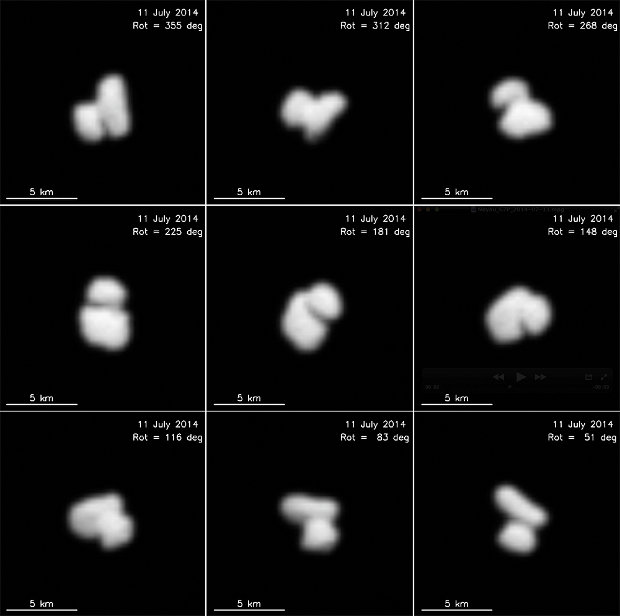
Assemblage of pictures that show the binary nucleus of the comet 67P/Churyumov-Gerasimenko taken by the Rosetta space probe (Image ESA / Rosetta / MPS for OSIRIS Team MPS / UPD / LAM / IAA / SSO / INTA / UPM / DASP / IDA)

ESA’s Rosetta space probe awakened in January 2014 after a journey that lasted almost ten years. In recent weeks, it started sending pictures of its target, the comet 67P/Churyumov-Gerasimenko. Yesterday, CNES, the French space agency, published a composition of photos taken on July 11 which show that the comet is composed of two nuclei that are attached, a fact that makes the Rosetta mission even more extraordinary.

Infrared image of the comet C/2014 C3 (NEOWISE) (Image NASA/JPL-Caltech)

The NEOWISE (Near-Earth Object Wide-field Infrared Survey Explorer) Space Telescope discovered his first comet after starting its new mission last year. On February 14, 2014, during one of its scans of space in search of objects that can cross the Earth’s orbit, it found a comet, which has been designated C/2014 C3 (NEOWISE). Astronomers quickly realized that it’s a weird comet because its orbit is retrograde.