Hardware

PlasticARM

An article published in “Nature” reports the creation of a flexible microprocessor based on plastic materials instead of silicon. A team of ARM researchers developed this processor that was called PlasticARM also because its Cortex-M0 core is based on ARM architecture, precisely ARMv6-M. It’s an extremely limited processor in its performance, as it has a frequency of 30 kHz and supports up to 128 bytes of RAM and 456 bytes of ROM. The aim was to produce a fully functional flexible processor so this is a starting point from which to develop processors for use in fields where flexibility is important such as wearables and other products connected via the Internet of Things such as medical devices.

Robotics company Boston Dynamics has released a video to celebrate what it hopes is a better year showing the ability of some of its robots to dance to the tune “Do You Love Me?”. In particular, two humanoid robots demonstrate their balancing skills by remaining on one leg at certain moments. In some parts of the video they’re accompanied by a quadrupedal robot and another robot that moves on two wheels.

Arm CEO Simon Segars

The leading graphics processor company NVIDIA has reached an agreement to buy the British microprocessor company Arm Ltd. from the Japanese telecommunications holding SoftBank Group Corp. for $12 billion in cash and $21.5 billion in shares. The agreement provides for an additional $5 billion that SoftBank could receive under certain conditions and $1.5 billion for Arm employees for a total of 40 billion dollars. The operation is expected to close in 18 months.

Parts of the Fugaku supercomputer (Photo courtesy RIKEN Center for Computational Science (R-CCS))

The Japanese supercomputer Fugaku was crowned the new king of the Top 500 ranking by passing Summit, which held the title for two years. Fugaku has almost triple performance compared to its predecessor with a computing power of 415.5 Petaflops against 148.6 for a theoretical peak of 513.8 Petaflops against 200.8. As has been common for supercomputer kings for a long time, it uses the Linux operating system, specifically the Red Hat Enterprise Linux 8 distribution. An interesting novelty is that Fugaku is the first supercomputer king based on ARM architecture being built around 2.2GHz A64FX 48C processors. In the Top 500 ranking, only three other supercomputers are based on ARM architecture.

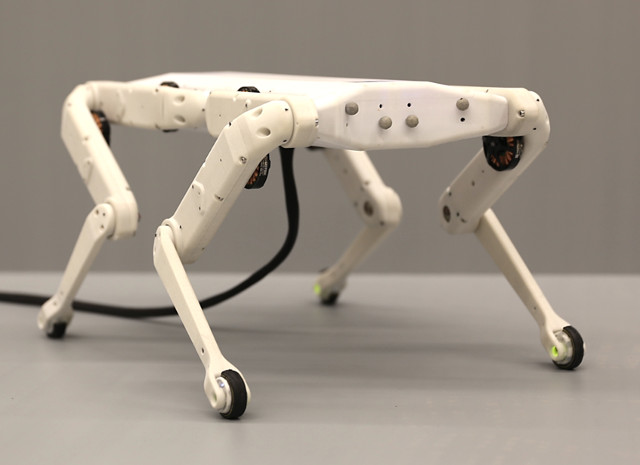
The Solo 8 robot (Photo courtesy Open Dynamic Robot Initiative)

An article accepted for publication in the journal “Robotics and Automation Letters” describes the design of a low-cost quadruped robot made available on GitHub under the free / open source BSD 3-clause license having been developed under the aegis of the Open Dynamic Robot Initiative. A team of researchers led by Ludovic Righetti of the Max Planck Institute for Intelligent Systems (MPI-IS) in Tübingen and Stuttgart, Germany, designed the robot Solo 8 using components such as torque control motors and actuators available in stores and components with 3D printing instructions available with the project. This made it possible to build a Solo 8 at a component cost of around € 4,000, still high, but less than a tenth of other robots with equivalent capabilities in performing sophisticated actions. The free license will allow others to further develop the project.