Informatics

Machine learning used to create new polymers

An article published in the journal “npj Computational Materials” reports the results of the use of a machine learning algorithm in the search for new materials. A team of researchers used an algorithm specialized in molecular design trained to recognize candidates with certain properties. In this way they designed polymers with high thermal conductivity, very useful to use for example in mobile technologies connected to 5G.

Screenshot from an IllustrisTNG simulation (Image courtesy IllustrisTNG project)

An article published in the journal “Computational Astrophysics and Cosmology” presents the complete public release of the simulations coded as TNG100 and TNG300 of the IllustrisTNG project, a highly sophisticated simulation of the universe that has been improved over years of work. A team of researchers kept on improving its details and functionalities also by developing new interaction and exploration 2D and 3D tools to simulate two cubes of space of 100 and 300 million parsec side length.

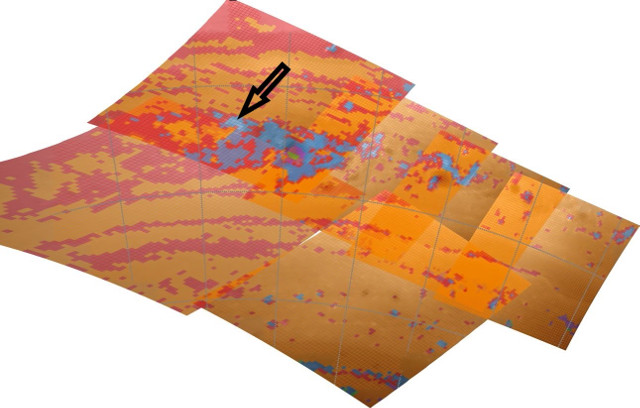
Deep learning used to map storms on the planet Saturn

An article published in the journal “Nature Astronomy” reports the application of a deep learning algorithm to recognize storms on the planet Saturn creating a map of their components and characteristics. Ingo Waldmann of the University College London, England, and Caitlin Griffith of the University of Arizona, USA, developed the algorithm called PlanetNet based on the TensorFlow “engine” to analyze data collected by the Cassini space probe with an efficiency higher than traditional techniques thanks to the recognition of recurrent characteristics across various multiple data sets. PlanetNet could be adapted to analyze observations of other planets.

Neural networks to predict the mass of planets in formation

An article published in the journal “Astronomy and Astrophysics” shows an example of the use of a neural network and a deep learning algorithm to reduce the time to create simulations of star systems formation obtaining even better results. Yann Alibert of NCCR PlanetS and of the Swiss University of Bern and Julia Venturini of the International Space Science Institute (ISSI) of Bern and a PlanetS collaborator developed this new system that predicts the mass of a planet starting from the conditions in which it formed with a excellent accuracy and a much higher speed than models based on differential equations.

IBM Q System One (Photo courtesy International Business Machines Corporation. All rights reserved)

At CES, IBM announced its first commercial 20-qubit quantum computer called IBM Q System One and the IBM Q Quantum Computation Center for its business customers. For some years IBM has been developing its own IBM Q quantum systems, also thanks to tests conducted allowing its customers the access to them via cloud and offering the possibility to develop specific applications, now the company has announced a system declaring a reliability comparable to that of a classic mainframe.