Linux

The Department of Energy’s (DOE) Oak Ridge National Laboratory has launched the new supercomputer Titan, a system that adopts the new Cray architecture that claims to have a peak power of twenty Petaflops. With such performances, Titan could become the most powerful supercomputers in the world surpassing Sequoia.

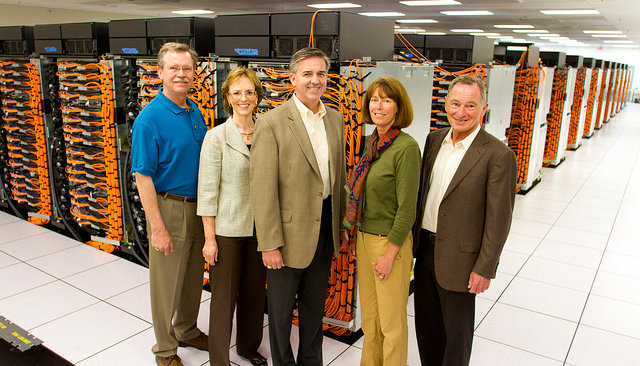
Some racks of the IBM Sequoia supercomputer

The Sequoia supercomputer, which uses Linux as its operating system, is based on the Blue Gene/Q architecture, the latest version of the architecture developed by IBM exactly to build supercomputers. Sequoia uses Power BQC processors with 16 cores clocked at 1.6 GHz stacked in 96 racks. The total number of cores is 1,572,864 for a total computing capacity of 16,324.8 TeraFlops. It has 1,572,864 GBytes (nearly 1.6 PetaBytes) of memory.

The micro-computer Raspberry Pi

The Raspberry Pi is a tiny computer the size of a credit card. That’s a project started about six years ago that has now finally seen the light. Yesterday its sales started and the success has been incredible, so much that the available computers were sold very quickly. The official project website was taken down because of the excessive traffic and the sites of its partners who resell the Raspberry Pi suffered high traffic problems.

Last month, Hewlett-Packard announced that it would release its webOS operating system as free / open source software after the debacle of the HP TouchPad tablet in the last summer. Now HP has announced the roadmap for the development of Open webOS, the free version of that operating system under the Apache License 2.0, which should lead to the release of its version 1.0 in September 2012.