Planets

Dust devil with its shadow on Mars surface (Image NASA/JPL-Caltech/Univ. of Arizona)

The Mars Reconnaissance Orbiter (MRO) is a NASA space probe designed to explore Mars from its orbit together with other probes and the Mars Rovers. On February 16, 2012 one of the instruments of the Mars Reconnaissance Orbiter, a huge camera called the High Resolution Imaging Science Experiment (HiRISE), captured images of a dust devil in the region called Amazonis Planitia, a large plain in the northern hemisphere of Mars.

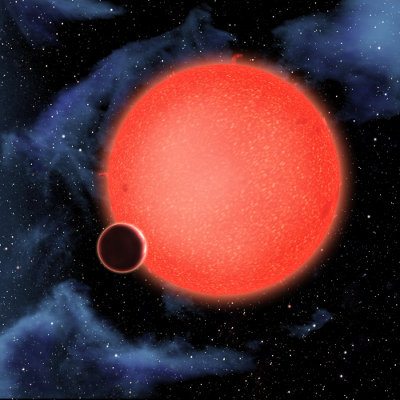
Artistic concept showing the planet GJ 1214b and its star (Image NASA, ESA, and D. Aguilar (Harvard-Smithsonian Center for Astrophysics))

The planet GJ 1214b was discovered in December 2009 using robotic observatory MEarth Project. Now an international team of astronomers led by Zachory Berta of Harvard’s Smithsonian Center for Astrophysics (CfA), confirms the theory proposed in 2010 that the planet GJ 1214b is covered by water in its vapor state.

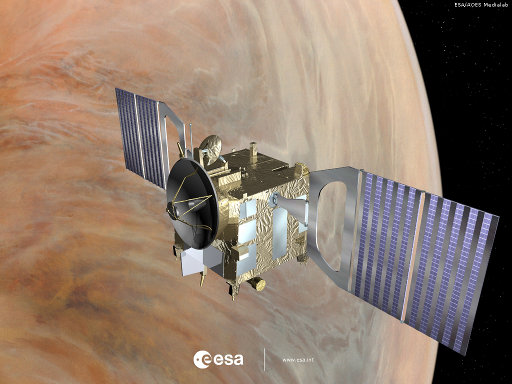
Artistic concept of ESA Venus Express space probe orbiting Venus (Image ESA)

Using the VIRTIS at infrared waves, the space probe Venus Express can study the surface of Venus despite the thick layer of clouds that cover it finding a change in the planet’s rotation speed.

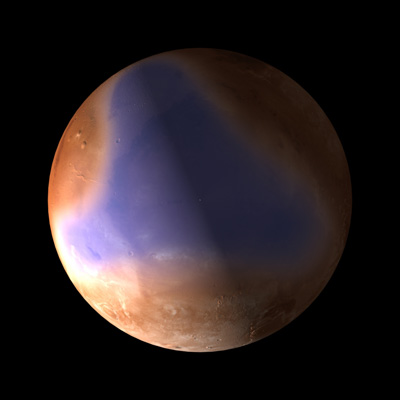
Artistic concept of an ancient ocean on Mars (Image ESA, C. Carreau)

Data received from the Mars Express space probe contain what are regarded as evidence that there was an ocean on Mars. The instrument used was the MARSIS (Mars Advanced Radar for Subsurface and Ionosphere Sounding), a radar developed by NASA and the Italian Space Agency.

A picture of Syrtis Major taken by the Mars Express Orbiter (Image ESA/DLR/FU Berlin (G. Neukum))

Discovered in 1659, Syrtis Major is a region of Mars with an area of ​​about 1,300×1,500 km (about 930×630 miles), thus about half of Europe. Initially, they thought it was a sea but today we know that this is a region of volcanic origin. Now the ESA Mars Express spacecraft has revealed new details of Syrtis Major.