Software

Parts of the Fugaku supercomputer (Photo courtesy RIKEN Center for Computational Science (R-CCS))

The Japanese supercomputer Fugaku was crowned the new king of the Top 500 ranking by passing Summit, which held the title for two years. Fugaku has almost triple performance compared to its predecessor with a computing power of 415.5 Petaflops against 148.6 for a theoretical peak of 513.8 Petaflops against 200.8. As has been common for supercomputer kings for a long time, it uses the Linux operating system, specifically the Red Hat Enterprise Linux 8 distribution. An interesting novelty is that Fugaku is the first supercomputer king based on ARM architecture being built around 2.2GHz A64FX 48C processors. In the Top 500 ranking, only three other supercomputers are based on ARM architecture.

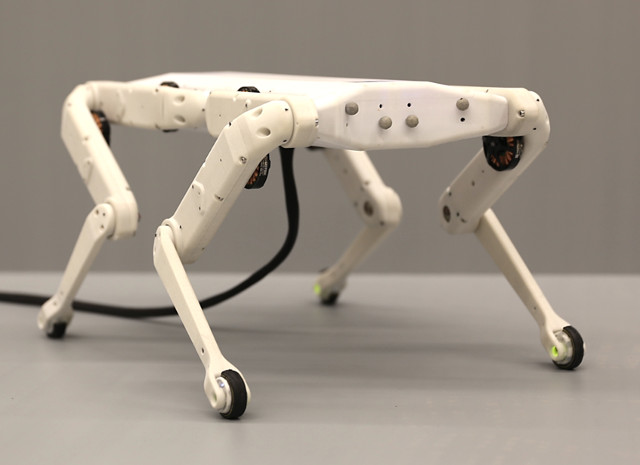
The Solo 8 robot (Photo courtesy Open Dynamic Robot Initiative)

An article accepted for publication in the journal “Robotics and Automation Letters” describes the design of a low-cost quadruped robot made available on GitHub under the free / open source BSD 3-clause license having been developed under the aegis of the Open Dynamic Robot Initiative. A team of researchers led by Ludovic Righetti of the Max Planck Institute for Intelligent Systems (MPI-IS) in Tübingen and Stuttgart, Germany, designed the robot Solo 8 using components such as torque control motors and actuators available in stores and components with 3D printing instructions available with the project. This made it possible to build a Solo 8 at a component cost of around € 4,000, still high, but less than a tenth of other robots with equivalent capabilities in performing sophisticated actions. The free license will allow others to further develop the project.

GW-BASIC

Microsoft has announced the release of the sources of GW-BASIC, the programming language that was part of the MS-DOS operating system up to version 4. They were made available on the GitHub website under the free / open source MIT license. Microsoft will not accept requests for changes sent through the GitHub system, but anyone can freely not only go to read the assembly code but also experiment with it, probably using a virtual machine. The published sources date back to February 10, 1983, and, as for versions 1.25 and 2.0 of the MS-DOS operating system released in September 2018, this was done for historical and educational reasons.

Gravitational lens candedates

An article published in “The Astrophysical Journal” reports the identifications of 335 new gravitational lens candidates discovered using machine learning software trained for this task. A team of astrophysicists led by Xiaosheng Huang of the University of San Francisco submitted images from the DECaLS investigation obtaining 335 possible gravitational lenses so far unknown. The verification will be carried out by humans, and 60 candidates have been included in the group that has the most chances of being confirmed. Gravitational lenses help astronomers in observing very far objects behind them, so the more are known the more likely they can be useful in some research.

PS4 (Image courtesy Sony)

Video games had an amazing evolution since their humble beginning and today you can enjoy them on a PC or buy a video game console with the power that not that long ago was limited to supercomputers at really affordable prices. Today there are many options for gamers and it can be confusing if you’re just having your first look into this world, but you just need to get some basic ideas to make the best choice for you.