Stars

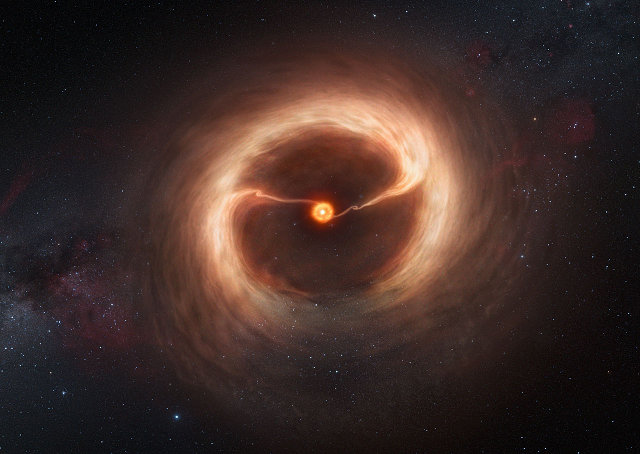
Artist’s impression of the disc of gas and cosmic dust around the young star HD 142527 with streams of gas flowing across the gap in the disc (Image ALMA (ESO/NAOJ/NRAO)/M. Kornmesser (ESO)/Nick Risinger (skysurvey.org))

Using the ALMA (Atacama Large Millimeter / submillimeter Array) telescope, an international team of astronomers has made the first direct observation of the formation of two gaseous planets around the star HD 142527. It’s a star that’s young in astronomical terms, with an age of about two million years more than 450 light years away from Earth.

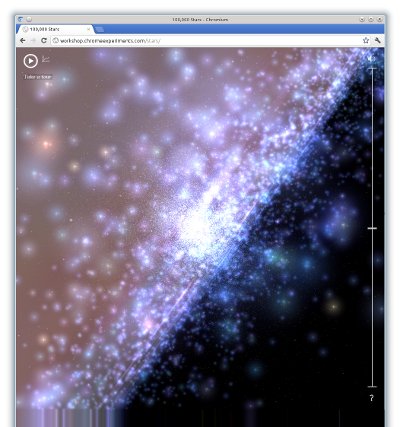
Screenshot from the 100,000 Stars application in Google Chrome

Google has put online a web application for its Chrome browser called “100,000 Stars” that allows you to explore an area of ​​the Milky Way which includes one hundred thousand stars. This is an interactive application with various features that allow to zoom in and out to go from the Sun to the entire “neighborhood” with all the possible intermediate steps.

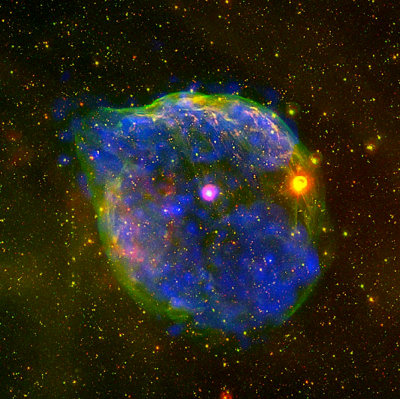
The Wolf-Rayet star EZ Canis Majoris at the center of a gas bubble (Image ESA, J. Toala & M. Guerrero (IAA-CSIC), Y.-H. Chu & R. Gruendl (UIUC), S. Arthur (CRyA–UNAM), R. Smith (NOAO/CTIO), S. Snowden (NASA/GSFC) and G. Ramos-Larios (IAM))

ESA’s XMM-Newton space telescope observed the star EZ Canis Majoris (EZ CMa), also known by the HD 50896 classification, which is about 5,000 light years from Earth. Represented with the pink color at the center of the image, it’s a really special star, because around it a gas bubble has formed which extends for about 60 light years.