Eta Corvi is a star in the constellation of Corvus with a mass nearly one and a half the Sun, from which it’s almost sixty light years away.
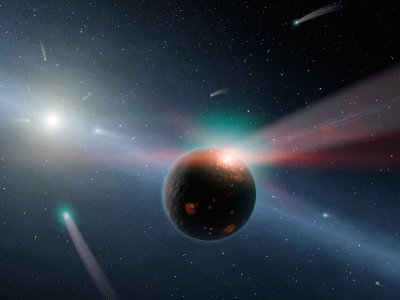
NASA’s Spitzer Space Telescope allowed scientists to study the Eta Corvi system finding signs of a comet rain that hit a rocky planet. The existence of one or more planets is yet to be confirmed by other types of observation but around the star at a distance a few times greater than that between the Sun and the Earth there’s a ring of dust composed of water ice, rock fragments and organic molecules that suggests a collision between comets and a planet.
In our solar system evidence of what’s called the late heavy bombardment have been found. Between 4.1 and 3.8 billion years ago a lot of asteroids and especially comets hit the inner planets, perhaps because of a migration by Jupiter and Saturn: their gravity might have influenced the motion of smaller objects but it’s a theory still under discussion. The estimated age of Eta Corvi is about a billion years, so it’s possible that its system is evolving in a manner similar to ours.
Already in 2005 it was discovered that in the Eta Corvi system there was another ring of cometary material for a total mass much greater than the one near the star but much farther away from it, about one hundred and fifty times the distance between the Sun and the Earth. In our solar system there’s a similar region called the Kuiper Belt and it’s believed that the asteroids and comets that hit the inner planets during the late heavy bombardment came from there. Nowadays the Moon still shows marks of the amount and the violence of the suffered impacts because of the lack of atmosphere and tectonic activity and therefore a lack of erosion of those marks.
[ad name=”Google Adsense 468″]
That bombing was certainly cataclismic for the Earth but it’s possible that the contribution of materials brought to the planet was crucial for the emergence of life. In fact, especially comets contain water, carbon and other organic materials and the fact that life was born at the end of that period may be seen as evidence for this theory.
At the moment we don’t know whether late heavy bombardments are common in planetary systems or they’re a rarity so the one in the Eta Corvi system has been discovered by luck. It’s therefore important to investigate further on this matter because not only it could shed more light on the early history of our solar system but it could also have a profound importance in the understanding of the birth of life.
