
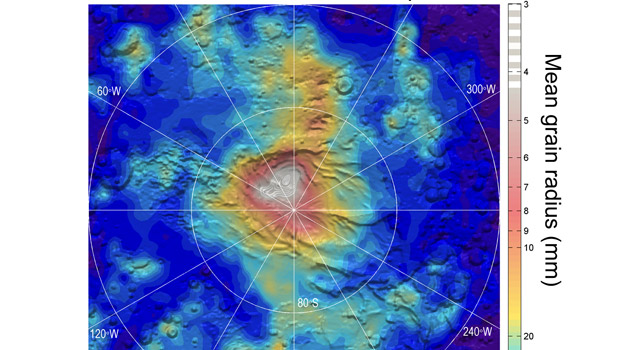
NASA’s space probe Mars Reconnaissance Orbiter (MRO) has provided evidence of snow made of dry ice, which is solid carbon dioxide, falls on Mars. It’s the only known example of this type of snowfall throughout the solar system.
Snow had already been discovered on Mars in 2008, when the Phoenix Mars Lander’s observations showed that in the northern hemisphere of the red planet there were clouds formed by water ice from which snow as we know it on Earth was falling. The temperature was about -65 degrees Celsius (-85 degrees Fahrenheit) but to have dry ice temperature should drop to -125 large Celsius (-193 degrees Fahrenheit).
At the South Pole of Mars, during the winter, the temperature drops to a level sufficient to freeze carbon dioxide. In the winter of 2006-2007, a persistent huge cloud about 500 km (about 300 miles) in diameter on the area has been identified and also other smaller clouds at latitudes from 70 to 80 degrees south. All those clouds were composed of carbon dioxide.
[ad name=”AmazonDocumentary”]
At the South Pole there’s a cape of dry ice throughout the year. A point to be clarified was whether the carbon dioxide would fall to the ground in the form of snow or if it froze touching the ground. The analysis of the data collected by the Mars Reconnaissance Orbiter suggests that dry ice snow falls.
A proof of a dry ice snowfall is given by the fact that the particles that make up the clouds are large enough to fall to the ground during the lifespan of the clouds. Another piece of evidence comes from observations made with the instruments pointed toward the horizon rather than towards the ground. The infrared spectra detected by the Mars Climate Sounder, one of the instruments of the Mars Reconnaissance Orbiter, indicate the presence of dry ice particles that extend down to the surface.
This research, which will be published in the Journal of Geophysical Research, represents a step forward in the understanding of the Martian climate. The effects of carbon dioxide as a greenhouse gas are well known on Earth and its behavior has considerable influence on the atmosphere of Mars and the processes that occur on the surface of the red planet.
