
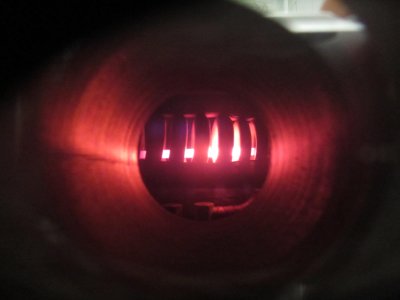
NASA stated that a group of researchers at its Marshall Space Flight Center have made a step forward on the road to the production of a nuclear-powered space rocket. The test used non-nuclear material to merely simulate some stress in terms of pressure and temperature that a rocket of this type should bear. Still, the Marshall’s Nuclear Thermal Rocket Element Environmental Simulator (NTREES) is considered a realistic simulator.
To be precise, the type of propulsion studied is the nuclear thermal type. In a rocket using that type of propulsion a fluid, typically liquid hydrogen, is heated to very high temperatures by a nuclear reactor and allowed to expand through a nozzle to generate thrust. Therefore, atomic energy is used in place of that generated by chemical reactions in conventional rockets.
A nuclear thermal rocket would generate a boost with an efficiency that is more than twice compared to that of a chemical rocket. Thus, to have the same thrust it’s enough to have a rocket with a mass reduced by half compared to a chemical rocket and using a thermal nuclear rocket for an upper stage of the rocket it would be possible to send into orbit a load twice as big compared to the stages using chemical propulsion.
For this reason, the idea of a nuclear thermal rocket has been taken into consideration in possible projects for deep space missions. The idea of using nuclear thermal propulsion isn’t new, actually it’s decades-old. Various tests have been conducted since the ’50s in the USA and the then USSR and the most promising were taken into consideration in the development of the Saturn V rocket and for the Space Shuttle launch system.
It’s obvious that safety is more than ever a problem when using a nuclear reactor that must fly over our heads. This was one of the reasons why for decades the projects of rockets of that type were abandoned. However, a test carried out in 1965 showed that the fall of a nuclear missile would release radiation in a small area only.
The Nuclear Cryogenic Propulsion Stage project that could be developed if the current tests will be successful consider safety as a major factor. Besides the fact that new materials and construction technologies available make it possible to limit the risks more than in the past, this nuclear thermal propeller would be used as the upper stage. It would be turned on only in orbit, to provide the last step of thrust to a spacecraft aiming to a deep space destination.
The name of this project is due to the fact that liquid hydrogen used for the thrust would initially be at extremely low temperatures and that’s why it’s called nuclear cryogenic. If successfully developed, it could become a part of the Space Launch System under development at NASA.
It’s soon to know if after decades of trials at NASA they’ll be able to produce a nuclear rocket working and safe. However, it’s clear that to expand the space program it’s necessary to produce a new generation of propellers more efficient than the huge and expensive chemical rockets currently used.
[ad name=”GANGeeks.com300″]
