
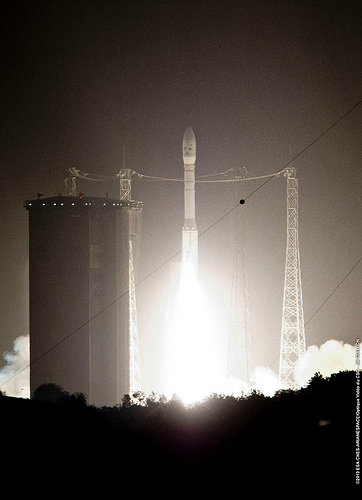
When it was night in French Guiana, from the Kourou base ESA’s Vega rocket was successfully launched in its VV02 mission. In the course of an operation that lasted almost exactly two hours, the satellites Proba-V, VNREDSat-1 and ESTCube-1 were put into two different orbits, demonstrating the great flexibility of the Vega launch system.
In February 2012 the Vega carrier rocket performed what is called qualification launch, meaning its first actual launch to bring some satellites in orbit with full success. The VV02 mission has the purpose to move forward towards launches that have a purpose also commercial showing extended capacity obtained with the Vespa (Vega Secondary Payload Adapter) adapter, which can bring different satellites into different orbits, the most important feature of this rocket.
The primary mission for this launch was putting into orbit the Proba-V satellite, the first of four ESA missions as part of the VERTA (Vega Research and Technology Accompaniment) program that specifically aims to demonstrate the flexibility of the Vega rocket. Proba-V is a small ESA’s satellite which has the purpose of mapping vegetation growth, in fact the “V” in its name means vegetation. It was put into a polar sun-synchronous orbit at an altitude of 820 km.
The Vespa adapter separated after putting the satellite Proba-V into orbit and, after a series of eninge burns, moved to put into a polar sun-synchronous orbit at an altitude of 668 kilometers the other two satellites. Those are the VNREDSat-1 (Vietnam Natural Resources, Environment and Disaster Monitoring Satellite) and the ESTCube-1.
The VNREDSat satellite is the first Vietnamese satellite and it aims to monitor climate changes in order to predict and take the necessary measures to prevent natural disasters and to optimize the management of Vietnam’s natural resources.
The ESTCube-1 satellite is of the CubeSat type, meaning a cubic nanosatellite that has an educations but also scientific purpose. It was built by the students of Tartu University, Estonian Aviation Academy, Tallinn University of Technology and the University of Life Sciences and developed in collaboration with the Finnish Meteorological Institute and the German Space Center (DLR). It will test a new solar sail technology to verify its possibilities as a form of propulsion. It’s the first Estonian satellite.
The VV02 mission was a full success and soon came comments rightly satisfied by ESA executives and Enrico Saggese, President of the Italian Space Agency (ASI), which gave the greates contribution among the European nations in the development of the Vega rocket.
Over the next two years four more launches of the Vega rocket are scheduled to bring various satellites into orbit. Its total success will be achieved when customers will be found willing to pay for commercial launches. At the time such services are offered on the Russian Dnepr and Rokot vehicles for less than the 35 million asked for a launch on the Vega rocket but in recent years they both have had various problems.
The Vega rocket has every chance to establish itself as a reliable carrier, an obviously major element in launching a satellite, and the improvements expected in the coming years could also lead to a lowering of the launch costs. In that case, it could really become a leader in the launch of small satellites.
[ad name=”Google Adsense 300″]
