
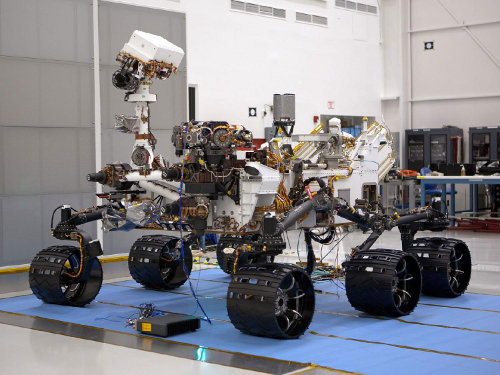
The measurements taken by the Sample Analysis at Mars (SAM) instrument of the Mars Rover Curiosity have provided evidence about the collapse of the ancient Martian atmosphere. The conclusions of the analysis of these data confirm that in the past the red planet had an atmosphere similar to that of Earth, much denser than at present. About 4 billion years ago, most of the Martian atmosphere dissipated in space.
The SAM instrument of the Mars Rover Curiosity has analyzed the various gases present in several samples of the Martian atmosphere. In particular, the analysis covered the different isotopes, variants of chemical elements, because the ratio of different isotopes may provide clues about the history of the atmosphere.
The heavy isotopes of carbon and oxygen in the carbon dioxide that makes up most of the Martian atmosphere are now in greater quantities than the distant past. This can be inferred from the proportions of isotopes present in the Sun and in other parts of the solar system. The conclusion is that the ancient light isotopes have dissipated into space.
Samples of ancient Martian atmosphere were analyzed thanks to discoveries of gas bubbles trapped in meteorites thrown from the Red Planet following impacts of asteroids and comets. Some of them have reached the Earth, where they were recovered and analyzed, confirming the different amounts of isotopes in the elements of the atmosphere existing in the remote past.
The analysis of other gases, mainly argon, suggest a catastrophic event that nearly 4 billion years ago caused a rapid loss of atmosphere. This conclusion is given by the ratio between the two forms of argon, one more primitive and the other created more recently by radioactive decay.
The causes of the loss of atmosphere are still under discussion. It’s possible that in the distant past Mars had a magnetic field that protected it from the solar wind, just like the Earth. As it cooled, Mars could have lost its magnetic field and the shield that protected its atmosphere.
More comprehensive and thorough analyzes of the Mars atmosphere are planned for the Mars Atmosphere and Volatile EvolutioN (MAVEN) mission. The MAVEN spacecraft is scheduled to be launched in November 2013 and enter Mars orbit in 2014. One of its objectives is precisely to understand why Mars has lost almost all of its atmosphere.
[ad name=”AmazonScience”]
