
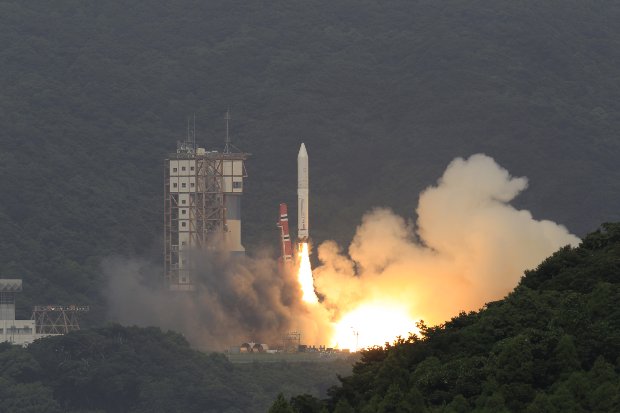
A few hours ago there was the first successful launch of the Epsilon Launch Vehicle in the mission called Epsilon-1 for this reason from the Uchinouora Space Center in southern Japan. After a little more than an hour there was the regular separation of the SPRINT-A satellite.
The solid-propellant rocket Epsilon was developed by JAXA, the Japanese space agency. It’s an evolution of the M-V – or M-5 or Mu-5 – rocket, also designed to launch satellites, but it uses a solid propellant booster of the type used for the H-IIA – or H2A launch system as its first stage. An updated version of the upper-stages of the old M-V rocket is used for the second and third stage of the Epsilon.
The Epsilon rocket is equipped with a series of automated control instruments which allow to make much more rapid inspections from the control center. In theory, the launch can be made in any part of the world while the inspection staff are in Japan and verify that everything is alright via a network-connected laptop that receives data from the automated systems of the Epsilon rocket.
The development of the Epsilon rocket has the aim to make the launch operations faster and cheaper. Of course, in the field of satellite launch cheap means less than $50 million. Plans are to launch small satellites for total masses up to 500 kg (about 1,100 lbs) but the Epsilon can launch up to 1,200 kg (about 2,600 lbs) meaning morethan one small satellite in a launch or a medium size satellite.
JAXA has been the victim of some cyber attacks, probably to steal data about its solid-fuel rockets. In fact, they’re perfect for military use because the rocket can be refueled and remain ready to use for long periods. Liquid fuels are highly corrosive so the supply must be carried out at the last possible moment, so they’re not suitable for missiles for military use.
The first satellite launched by rocket Epsilon has been the Planet Spectroscopic Observatory for Recognition of Integration of Atmosphere (SPRINT-A), a space telescope that aims to observe the atmosphere and the magnetosphere of the planets in the solar system from the low Earth orbit.
It’s a success for Japan, which in the last decade has strongly developed its own space program. The Epsilon Launch Vehicle got added to the H-IIA and H-IIB rockets. The next Epsilon launch, however, should take place only in 2015, with the launch of the Japanese Energization and Radiation in Geospace (ERG) satellite.
[ad name=”AmazonElectronics468″]
