
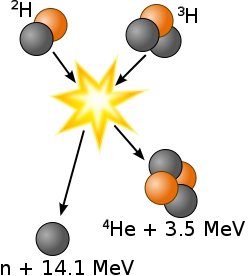
Controlled nuclear fusion has been considered for decades one of the possible solutions to the world’s energy needs. The amount of energy obtained would be really huge but the problems to solve seem even bigger. In short, so far the energy used to obtain the reaction was greater than that emitted. However, in recent days two different reports of progress arrived.
Scientists at the National Ignition Facility (NIF) in Livermore, California in one of the experimental reactors in which research is conducted on nuclear fusion, succeeded for the first time in obtaining an amount of energy from the hydrogen used equal to that supplied. During the experiment, in fact not all of the energy sent has reached the hydrogen because the system is still not efficient enough. This, however, means that the hydrogen fusion reaction has produced more energy than it received.
This result was achieved with an extremely powerful and sophisticated laser system. 192 laser beams are focused on a target called a hohlraum, a cylindrical container that absorbs energy and re-radiates it in the form of X-rays that heat up a pellet of deuterium and tritium, two isotopes of hydrogen. The inner part of this pellet is also compressed until it reaches the conditions in which nuclear fusion is triggered. The radiation emitted in the form of alpha particles and neutrons further warm the nearby areas maintaining the reaction uniform.
One of the problems caused by the nuclear fusion of hydrogen is that the high energy neutrons require the use of heavy shielding that become radioactive. An experiment devised by a team led by Christine Labaune of the École Polytechnique in France could solve this problem by using a different type of fusion.
This new idea is based on the use of boron-11, a boron isotope. Using a laser system similar to the one used at NIF, the team led by Christine Labaune hit boron-11 plasma and from the other direction hit it with a proton beam. The result was the production of beryllium atoms and alpha particles, evidence of nuclear fusion.
This experiment is still a proof-of-concept. Boron is an abundant element but the energy from its fusion is far too little to have a positive balance. However, it’s useful as a basis for new experiments, also for other types of nuclear fusion reactions.
It will still take more steps forward to be able to use nuclear fusion normally as an energy source but researchers are making significant progress.
[ad name=”AmazonDocumentary”]
