
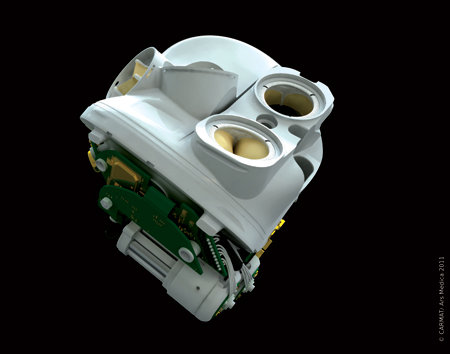
A new type of artificial heart has been approved for human tests in France, Belgium, Poland, Slovenia and Saudi Arabia. The goal is to apply for a business license in the European Union and seek an American partner to extend the offer in the USA. The peculiarity of this artificial heart is that it was built using the space technology developed to build satellites.
This artificial heart was produced by Carmat, a company founded in 2008 by cardiac surgeon Alain Carpentier with the support of the French government. The company is a spin-off of EADS (European Aeronautic Defence and Space Company NV), a European corporation in the field of transport, including aerospace. Astrium is a subsidiary of EADS specialized in aerospace services and Professor Carpentier worked with it for 15 years to adapt space technology to cardiology needs.
The production of an artificial heart is one of the great technological challenges of recent decades. Unfortunately there are many thousands people with serious heart problems who need a transplant but the amount of available hearts is definitely not enough. The creation of an artificial organ with reduced size and weight and at the same time with the reliability needed is really hard but now it seems that Carmat did it thanks to a seemingly unlikely partnership.
In fact, despite all the differences, space and the inside of a human body have things in common. They are both harsh and inaccessible environments. The technologies developed for satellites must pass very strict tests so their reliability is that required for an artificial organ.
Thanks to the latest developments in electronics, size and weight are reduced enough to create a heart that weighs about 900 g (about 2 lb), which is about three times an organic heart. Its size makes it suitable for about 86% of men but only 20% of women. Men make up the vast majority of people with serious heart problems and in the future later models will likely be even smaller and lighter to be suitable for a greater amount of women.
Another problem in the production of artificial organs is the need to be biocompatible. The heart created by Carmat uses biological tissues treated to reduce the immune response in the parts that come in contact with blood. In the end, this product is the result of the encounter between space technology and medical science at their most sophisticated levels.
[ad name=”AmazonDocumentary”]
