
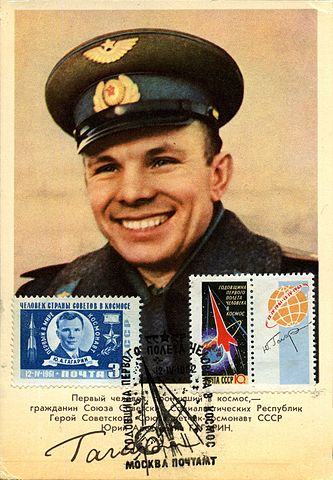
Yuri Alekseyevich Gagarin was born on March 9, 1934, in the village of Klushino, in the then USSR.
Since his childhood, Yuri Gagarin was noted for his skills in science but in 1941 he had to interrupt his studies because of the German invasion. During those years, he became interested in flight and after his graduation, he joined a flying club. In 1955 he was drafted into the Soviet Armi and was sent for training as a pilot in the Soviet Air Force Academy at Orenburg, where he graduated in 1957. There he met Valentina Ivanovna Goryacheva, who became his wife in 1957. The two of them had two daughters.
In the two following years, Yuri Gagarin was assigned to the Air Force Base of Luostari, where he distinguished himself even more in the course of the training. In 1960 he was chosen together with 19 other pilots for the Soviet space program. At the end of the tough selection tests, he became the first candidate for the first Vostok mission.
On April 12, 1961, Yuri Gagarin made the first historic human journey into space in the Vostok 1 spacecraft orbiting the Earth. He thus became a national hero, used by Soviet propaganda. These were the years of the Cold War and for many defeating the Americans was more important than having reached a historic milestone.
In later years, Yuri Gagarin worked for some soviet space missions such as the Vostok 6, which brought the first woman in space, Valentina Tereshkova. He was the backup cosmonaut in the Soyuz 1 mission, controversial because of the spacecraft’s serious problems. The pilot Vladimir Komarov died during the emergency landing on April 24, 1967.
Yuri Gagarin was among those who had demanded increased security measures since before the tragic flight of the Soyuz 1. For this reason, he was banned from the Soviet space program and returned to serve as a military airplane pilot.
On March 27, 1968, Yuri Gagarin died when the MiG-15UTI he was flying on crashed to the ground. The reasons for the accident were never completely clarified: at that time, in the USSR it was normal that in such events investigations were conducted very confidentially, so much that even the KGB was involved. For these reasons, in the following years, someone created various conspiracy theories but there’s no evidence that the death of Gagarin was caused intentionally.
Yuri Gagarin received many honors during his life and many others were posthumous. The posthumous tributes have been made over the years in important moments such as the first landing of humans on the Moon and the 50th anniversary of his flight. Even today, flying in space carries risks, in 1961 it was a truly amazing achievement. For this reason, despite the Cold War, Yuri Gagarin was always highly respected beyond ideology.
