
On April 5, 2014, the American Museum of Natural History in New York opened an exhibition devoted to pterosaurs that will last until January 4, 2015. This has brought to the spotlight those ancient reptiles and the knowledge accumulated over time on them thanks to research carried out by many paleontologists from around the world.
Pterosaurs are an order of reptiles that lived in the Mesozoic Era, between 220 and 65 million years ago. They weren’t dinosaurs, although they were related to them, but a separate order of reptiles. Their classification is still controversial because the amount of fossil is limited although recent discoveries are at least providing a better evolutionary tree of the various species.
The traditional classification into two suborders, Rhamphorhynchoidea and Pterodactyloidea, was at least partly abandoned as a result of new discoveries. Nevertheless, there are still doubts about the exact relation among the various species. Nor is it clear who is the ancestor of the pterosaurs, though someone believes that it may be the Sharovipteryx, a kind of flying lizard that lived in the Triassic period.
Pterosaurs didn’t generally live in the kind of areas where animal carcasses fossilize. Their fragile bones preserved poorly so pterosaur fossils are often incomplete. In many cases, paleontologists have put together information gathered from partial skeletons of several specimen. Sometimes, they’re forced to infer some missing features based on those of similar species.
What is certain is that pterosaurs had great success in the Mesozoic and ruled the skies for over 150 million years. The first pterosaur fossil was discovered in 1784 by naturalist Cosimo Collini but he thought that it was an aquatic animal which used its long front limbs as paddles. The first to suggest that pterosaurs were flying animals was Georges Cuvier in 1801, coining the term pterodactyls, which continued to be popular.
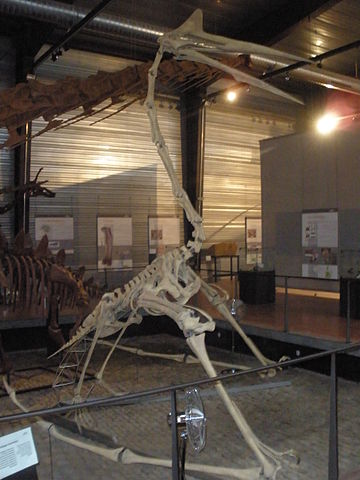
Over time, many species of pterosaurs have been discovered. One of them, the Quetzalcoatlus northropi (photo ©Ghedoghedo), was really impressive with a weight of 200 kg (about 440 lbs) and a wingspan that probably was up to 10-11 meters (about 33-36 feet). again, its exact characteristics are hypotheses because only partial skeletons were found.
The new technologies allow more sophisticated analyzes of fossils so our knowledge of pterosaurs are improving over time. The exhibition at the American Museum of Natural History in New York is an opportunity to discover the state of the art of the studies of these fascinating reptiles that dominated the air in the Mesozoic.
[ad name=”eBayUSUKFossils”]

Permalink