
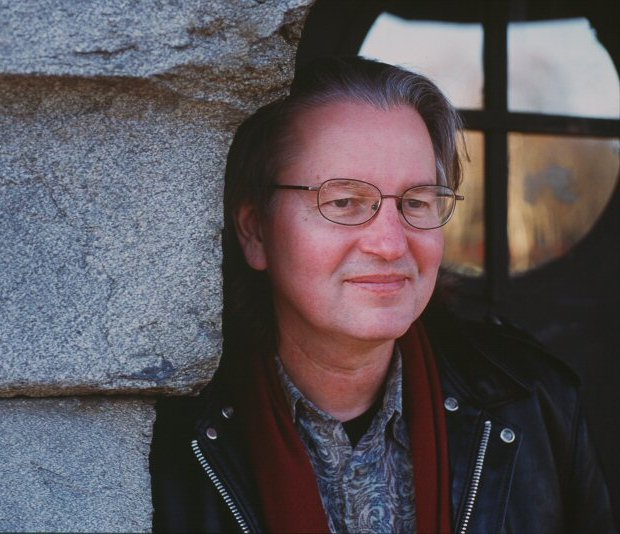
Michael Bruce Sterling (photo ©Pablo Arenas Balbontin) was born on April 14, 1954, in Brownsville, Texas, USA.
After graduating in journalism from the University of Texas at Austin in 1976, Bruce Sterling published his first short story, “Self Made Man”, in the magazine “Lone Star Universe”. He’s always been a sort of part-time writer, alternating the production of literature with other jobs.
After graduating, Bruce Sterling initially worked as a proofreader for the Legislative Council of Texas. After spending a few years in India, he started working as a journalist, starting a column about science in the magazine “Magazine of Fantasy and Science Fiction” and one of literary criticism in the journal “Science Fiction Eye”.
In 1977, Bruce Sterling published his first novel, “Involution Ocean”, which is in many ways a science fiction version of “Moby Dick”. It was released as part of a series of new authors discovered by Harlan Ellison.
In 1980, Bruce Sterling published the novel “The Artificial Kid”, set in a distant future where a boy continuously films himself using remotely controlled cameras.
In subsequent years, Bruce Sterling started writing cyberpunk stories, heavily contributing to defining this subgenre. In 1985, he published the novel “Schismatrix” which, together with “Neuromancer” by William Gibson, defined cyberpunk. The novel is part of Sterling’s Shaper/Mechanist universe, along with several short stories written since 1982.
In 1988, Bruce Sterling published the novel “Islands in the Net”, winner of the Campbell Award. It’s the second novel by this author, crucial to cyberpunk, set in the early 21st century in a situation that apparently tends toward utopia, but actually has many problems.
In 1990, Bruce Sterling and William Gibson worked together to write the novel “The Difference Engine“, one of the main products of the steampunk subgenre.
In 1994, Bruce Sterling published the novel “Heavy Weather”, which anticipated the consequences of global warming, described in 2031, in which it’s set. The author also extrapolates social problems and possible technological developments, such as drones.
In 1996, Bruce Sterling published the novel “Holy Fire”, set in a future where advanced genetic technologies are available, and people can greatly extend their life. The story shows the negative consequences of such technologies.
In 1998, Bruce Sterling published the novel “Distraction”, which won the Clarke Award, which tells a clash also political for the control of a laboratory for technological research after the collapse of the USA.
In 2000, Bruce Sterling published the novel “Zeitgeist”, more of a thriller than a science fiction story, set in 1999. One of the protagonists, Leggy Starlitz, had already appeared in some of Sterling’s stories.
In 2004, Bruce Sterling published the novel “The Zenith Angle”, a technological thriller that features a hacker whose life changes after September 11, 2001. The story includes many of the themes that have been part of the author’s previous stories.
In 2009, Bruce Sterling published the novel “The Caryatids”, the story of four female clones of a Balkan warlord in exile on an orbital space station. These women may be the last hope of saving the Earth from an environmental collapse.
In 2012, Bruce Sterling published the novel “Love Is Strange”, the strange love story of two people who can read the future. They both know that their story is bound to end, and it’s not what others expect.
In 2003, Bruce Sterling was appointed a professor at the European Graduate School, where he teaches summer intensive courses in media and design. For some time, he lived in Belgrade, Serbia, where he married the writer and director Jasmina Tesanovic. In 2007, he moved to Turin, Italy, where he collaborates with some Italian newspapers and with the Italian edition of Wired.
Bruce Sterling had a significant influence on science fiction over the past 30 years. His activities are also carried out regularly in newspapers and magazines of various nations, where he writes about the possible future, also in relation to current social and political problems. He often travels around the world to speak at conferences, so he’s well known even outside the field of science fiction.

Permalink