April 2014

The novel “Winner Takes All” by Jacqueline Rayner was published for the first time in 2005.

The Ninth Doctor brings Rose back to her home after she discovered that her mother Jackie won in a lottery. When the two travelers arrive, they realize that a really extraordinary event has started with a mass involvement. Participants can win a holiday or a game console. Jackie won a console and gave it to Mickey.

The Doctor and Rose try to understand the reasons for so much excitement, also for the game “Death to Mantodeans”, which comes along with the prize console. The awards are apparently normal but the people who win a holiday never return home and the videogame soon turns up to be far too realistic with an alien involvement.

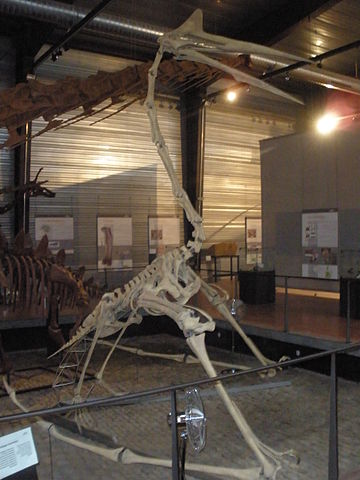
Quetzalcoatlus fossil

On April 5, 2014, the American Museum of Natural History in New York opened an exhibition devoted to pterosaurs that will last until January 4, 2015. This has brought to the spotlight those ancient reptiles and the knowledge accumulated over time on them thanks to research carried out by many paleontologists from around the world.

Artistic concept of the possibile interior of Enceladus with its ocean and geysers (Image NASA/JPL-Caltech)

A new analysis of the navigational data from NASA’s Cassini space probe allowed to obtain new information about the ocean of liquid water beneath the surface of Enceladus, one of Saturn’s moons. This research, coordinated by Luciano Iess of the department of mechanical and aerospace engineering at Rome’s University La Sapienza, was carried out by a team of Italian and American researchers exploiting the influences of the very small gravitational changes on Cassini’s movements.

Only 10 days after his appointment, Brendan Eich (Photo ©Darcy Padilla) has resigned as CEO of the Mozilla Foundation. His decision came as a result of the open accusations of homophobia against him, with the resignation of three of the six members of the board of directors and various threats and calls for boycotts against Mozilla products, starting with the Firefox browser.

The Sentinel-1A satellite on the Soyuz rocket right after liftoff (Photo ESA–S. Corvaja)

A few hours ago, the Sentinel-1A satellite, the first of the GMES / Copernicus program, blasted of from the Kourou spaceport, French Guiana, on a carrier rocket Soyuz-STA/Fregat. Soon after, the satellite regularly separated from the upper stage of the rocket and started sending signals. A few hours later it started deploying its solar panels.